NASA's funding for research and analysis programs has stagnated for 15 years, affecting its scientific capabilities and future leadership.
A detailed investigation has revealed that NASA's financial commitment to its research and analysis (R&A) programs has remained largely unchanged for the past 15 years. Despite recommendations from community-driven decadal surveys and mandates from Congress, funding has effectively decreased by 30% when adjusted for inflation, representing a worrying trend for the agency.
Mark Sykes, a prominent planetary scientist, emphasizes the critical implications of this funding stagnation in his accompanying blog post. He points out that “NASA is losing the intellectual content needed to identify and answer the breadth of significant scientific questions it is faced with today and it is losing the community of scientists (young and old) our nation needs to pursue these questions and maintain leadership in the world.”
Examining the Financial Landscape
R&A programs are vital, financing openly competed proposals that form the backbone of NASA's overarching mission and research avenues, which include acclaimed projects like space telescopes, interplanetary missions, and lunar exploration.
In the most recent two planetary science decadal surveys, conducted in 2011 and 2022, the scientific community urged NASA to increase its funding for R&A efforts. The goal was not only to expand research but to ensure that funding increases kept pace with inflation rates. Meanwhile, congressional directives, such as those from the 2022 CHIPS and Science Act, aimed for R&A to constitute at least 10% of the annual budget for relevant divisions of NASA’s Science Mission Directorate by fiscal year 2025.
While these recommendations aren't legally binding, turning a blind eye towards them diverges from established norms. Sykes managed to obtain R&A funding data through FOIA requests and public documentation. Unfortunately, R&A isn't transparently listed in NASA's budget but is instead dispersed across various programs.
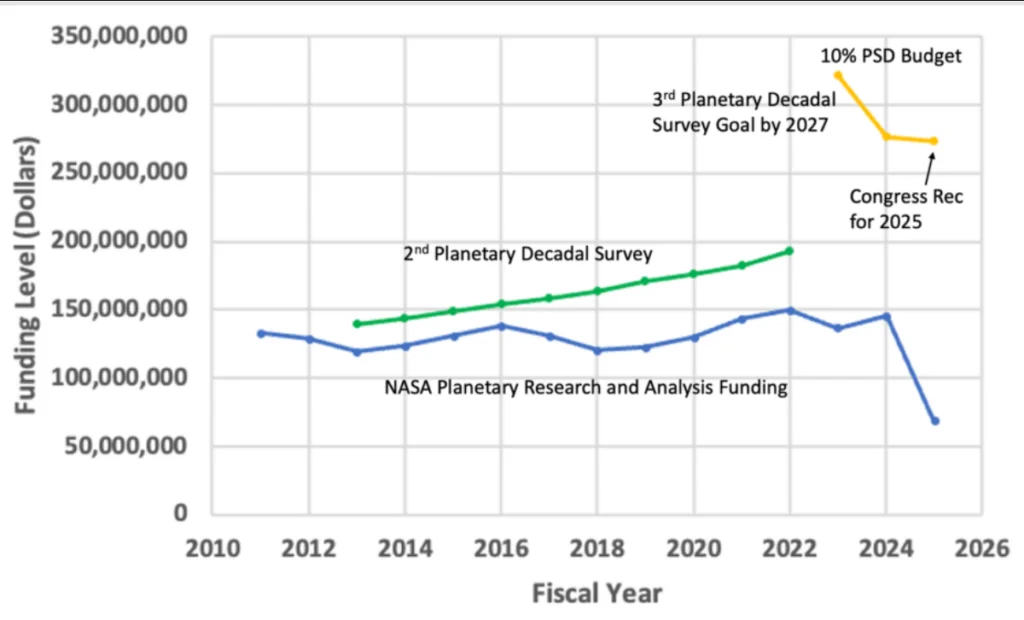
The data illustrates that even as early as 2013—just after the first survey recommendations were published—spending on planetary R&A was already notably lower than the suggested funding levels. This discrepancy has only widened over time.
The 2022 survey's strong recommendations, combined with congressional directives to enhance R&A budgets to 10% of the Planetary Science Division (PSD) finances, are glaringly unmet. By 2023, R&A constituted merely 2.5% of the PSD budget, resulting in a funding deficit of approximately $185 million.
Impact on Scientific Research
The only significant adjustment to R&A expenditure since 2011 is a budgeted $144 million for FY2025, a number that remains flat when accounting for inflation. As this fiscal year progresses, only 47% of that budget had been spent halfway through, raising red flags about future allocation utilization.
Sykes has raised concerns about whether the budget figures for FY2026 and FY2027 reflect the actual spending from FY2025. He noted that NASA holds two years to disburse its allocated funds, but typically, these funds are utilized by the end of the fiscal period.
“It would be pretty notable for NASA to incur costs amounting to 50% of its R&A budgets in the last three months!” Sykes remarked, suggesting that recent funding behavior illustrates a significant shift within the Administration's financial management.
This investigation, spanning 15 years across eight NASA administrators and four presidential administrations, showcases a gradual erosion of support for NASA and scientific research. The systemic underfunding seen isn’t easily pinned on any one individual or administration; rather, it seems to be a broad trend.
However, the ramifications are stark. Coupled with proposed cuts to science funding, discouragement of international academic collaborations, and staff reductions at NASA, the future of the U.S. in scientific leadership appears increasingly precarious, according to Sykes. “The U.S. may not recover,” he asserts.
—Kimberly M. S. Cartier (@astrokimcartier.bsky.social), Staff Writer
Contributing Knowledge
If you have insights into how legal or policy changes are shaping scientific research, don’t hesitate to reach out at [email protected].



Discussion
Sign in to join the discussion.