Recent observations reveal unexpected variations in Chariklo’s rings, prompting scientific inquiry into their evolving nature and potential drivers.
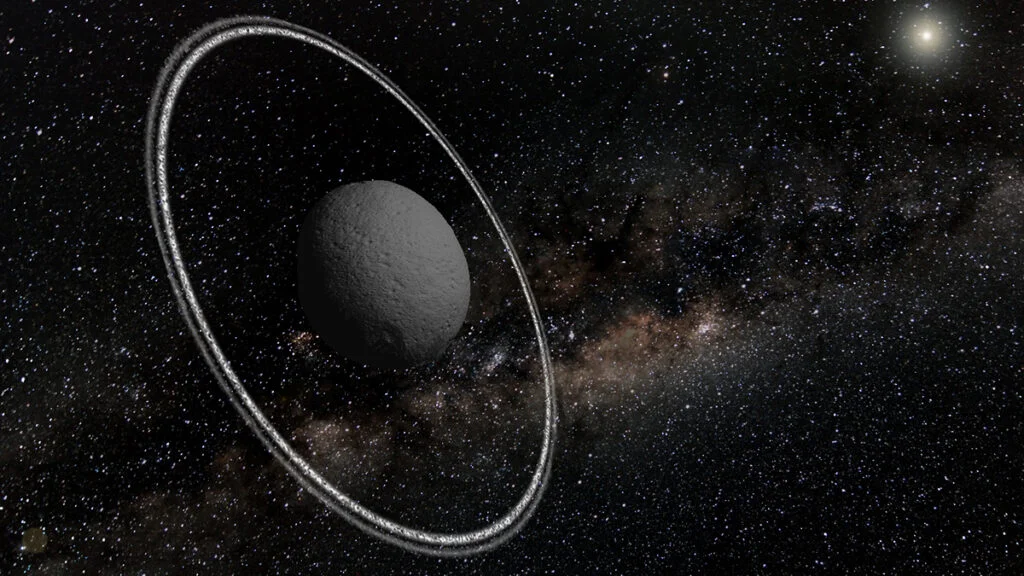
Tiny asteroid Chariklo, residing in the space between Saturn and Uranus, is unique for possessing two rings, a first among asteroids. Their initial discovery in 2013 took astronomers by surprise, and new findings suggest these rings are undergoing intriguing changes.
Pablo Santos-Sanz, an astrophysicist at the Instituto de Astrofísica de Andalucía in Spain and lead researcher, notes, “The opacity of the outer ring is now lower than in previous observations, but the inner ring’s opacity has increased.” This discrepancy raises questions about the dynamics at play.
Dynamic Observations
Chariklo is classified as a Centaur asteroid, orbiting the Sun approximately 2.3 billion kilometers (1.5 billion miles) away, with a diameter of 302 kilometers (about 108 miles). Its peculiar shape and orbital trajectory make it a captivating subject for astrophysical studies.
The rings were first detected when Chariklo passed in front of a distant star during a stellar occultation. This event caused the star's light to dim, first twice before and then twice after Chariklo obscured it, revealing the presence of the rings. Chariklo became only the fifth known solar system object with a ring system, following the four giant planets.
Subsequent research indicated that the rings are thin, sharply defined, and separated by just 14 kilometers (8.7 miles). There is also speculation about the potential presence of water ice within the rings.

Observing such a dim ring system is challenging, and repeated occultations are rare. In an effort to provide more data, Santos-Sanz and his team sought opportunities through the James Webb Space Telescope (JWST), positioned at the L2 Lagrange point, approximately 1.5 million kilometers from Earth. They accurately predicted the likely positions of Chariklo and JWST by analyzing extensive data from the Gaia mission.
The complexity of this observation was substantial, with uncertainties involving each object's trajectory, especially JWST's, which complicates any long-term predictions about its position.
“At the beginning I felt like a crazy guy proposing this.”
Despite these difficulties, the researchers identified an impending alignment in October 2022 that would allow JWST to pass through Chariklo's occultation shadow. After rigorous calculations and planning, the team successfully conducted the observation, leading to the exciting confirmation of significant changes in the ring structures. Notably, while the inner ring's opacity increased by 42%, the outer ring was found to be incredibly faint.
The findings were made public on September 9, 2026, in Science Advances.
Rings on Shifting Paths
The current mystery lies in understanding why the opacity of the rings has diverged. One possibility is that collisions among particles in the inner ring are altering their reflective properties, while particles in the outer ring might be dispersing. Alternatively, Chariklo could host an undiscovered moon affecting the rings' stability and evolution.
Heikki Salo, an astronomer at the University of Oulu in Finland, emphasizes the lack of comparative data to form a definitive understanding. He remarks, “Existing observations of miniature ring systems are scarce compared to their larger planetary counterparts, yet the dynamics governing these small ring systems are equally complex.”
“It’s a piece in the big puzzle that is solar system science.”
Salo also suggests Chariklo’s unusual shape may significantly influence the stability of its rings. The asteroid’s gravity impacts the orbits of particles, potentially explaining the evolving characteristics observed. He draws an intriguing parallel between Chariklo’s rings and Saturn's F ring, which also displays variant structures over time.
Looking ahead, the next opportunity to observe Chariklo's rings may be several years away. Until then, the scientific community will continue to seek clarity regarding this puzzle in solar system science. As Santos-Sanz puts it, “In a few years we will have more pieces to better understand what's happening not just in Chariklo but also in other ringed objects like Haumea, Chiron, and Quaoar.”
—Kimberly M. S. Cartier (@astrokimcartier.bsky.social), Staff Writer


Discussion
Sign in to join the discussion.