A hot white dwarf may be absorbing the atmosphere of a planet formed from material its predecessor star shed before dying.
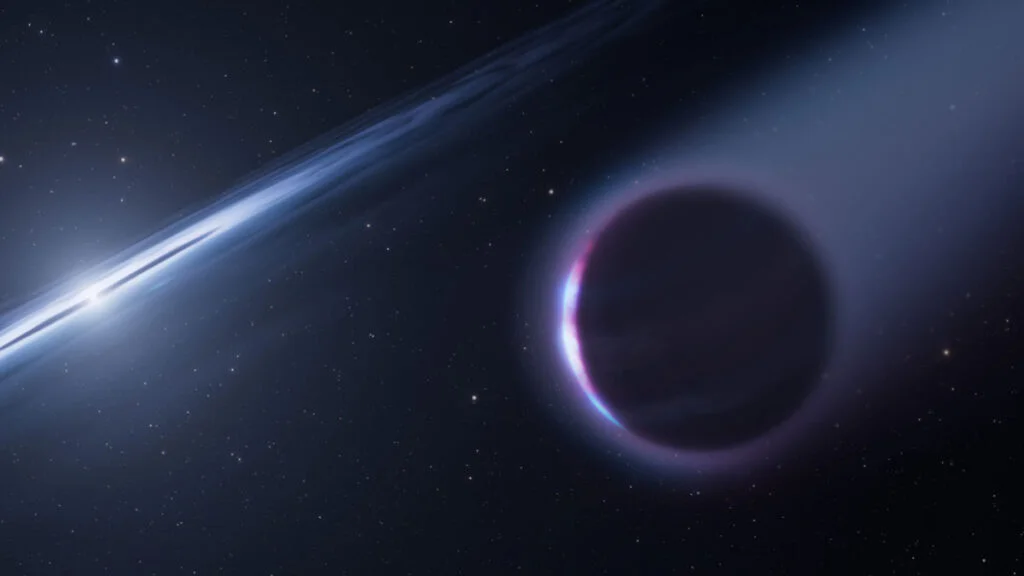
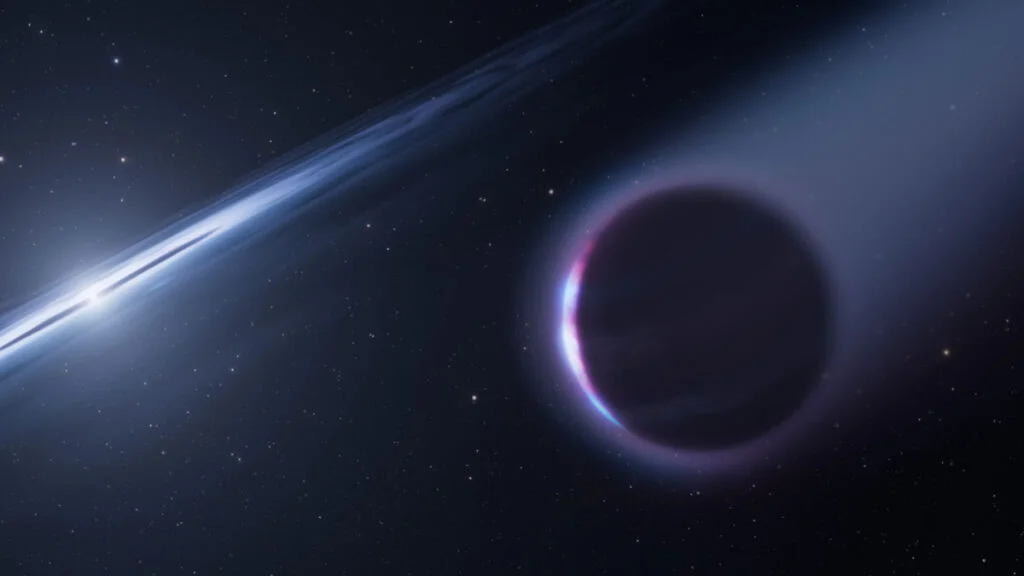
A white dwarf’s atmosphere may be recording an unusual planetary life cycle: material from a dying star formed a new planet, and the stellar remnant is now stripping that planet’s atmosphere. The evidence comes from HS 0209+0832, whose chemical makeup differs sharply from other known polluted white dwarfs.
The observations point to a candidate “second-generation” planet, assembled from debris the star expelled near the end of its life. The study, led by University of Warwick astronomer Jamie Williams, was published in Nature Astronomy. Its most striking chemical clue is niobium, detected in a white dwarf for the first time, alongside unusual amounts of copper and zinc.
“This white dwarf is unique because it has a lot of traces of copper, zinc, and niobium,” Williams said. “Niobium is especially interesting [because] that’s the first time it’s ever been discovered in a white dwarf.”
Elements heavier than hydrogen and helium in a white dwarf’s atmosphere are commonly treated as evidence of “pollution”—material drawn in from a planetary body. That material could come from a planet destroyed as its star evolved, or from a surviving object in the system. In HS 0209+0832, the element mix suggests a more unusual source.
“I don’t know of any other source that comes close to being this strange,” said Juliette Becker, a planetary astronomer at the University of Wisconsin–Madison who wasn’t involved in the research. “This [white dwarf] is very different from pollution profiles that have existed so far, which is very exciting.”
Clues in the light
HS 0209+0832 is about half the Sun’s mass and roughly Earth-sized—ordinary proportions for a white dwarf. But it’s young and exceptionally hot, with a temperature around 35,000 kelvin, or about 63,000°F. The Sun’s surface, by comparison, is about 5,800 kelvin. The white dwarf emits most strongly in ultraviolet light.
A 1999 observation with the Hubble Space Telescope revealed more helium in the star’s atmosphere than expected. At such a high temperature, a white dwarf should contain little atmospheric helium. To investigate the anomaly, Williams and colleagues combined later Hubble observations with data from the Far Ultraviolet Spectroscopic Explorer (FUSE) and the Transiting Exoplanet Survey Satellite (TESS), among other sources.
The expanded data set exposed additional elements, including a niobium abundance three times higher than in the Sun’s spectrum. Comparisons with other polluted white dwarfs, as well as comets and meteorites in our solar system, failed to turn up a close match. The composition made a planet-derived source plausible, while TESS offered a separate clue.
TESS recorded changes in the system’s visible brightness. Williams and his colleagues interpret the pattern as a day-night phase curve: the planet’s changing orientation makes different sides face Earth as it orbits. The cycle repeats every 4.4 days, consistent with a close-orbiting world of the type called a “hot Jupiter.”
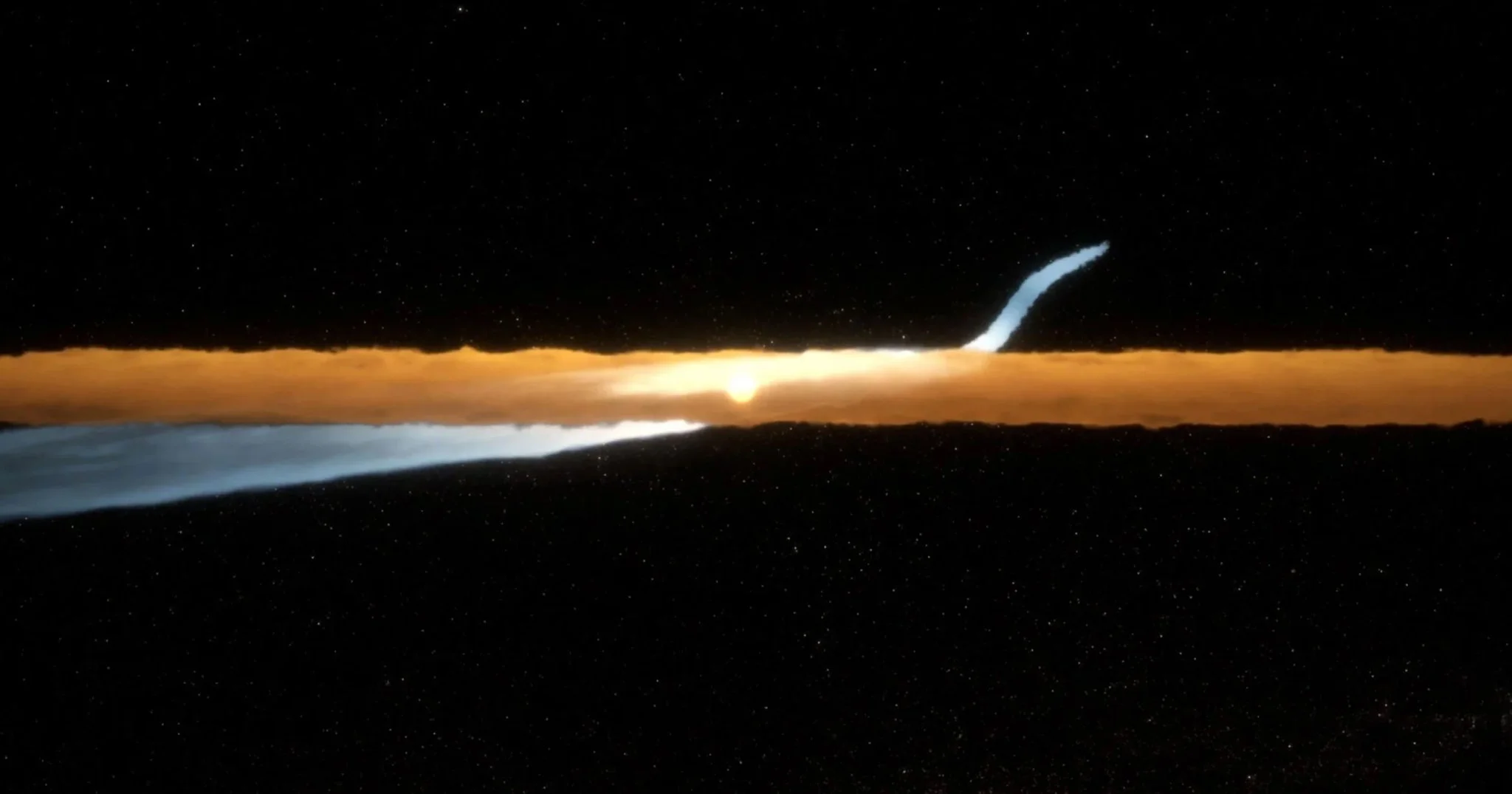
Together, the chemical profile and brightness variations support a planet candidate whose ingredients reflect the star’s final stages. In the researchers’ favored scenario, the progenitor star shed gas rich in zinc, copper, and niobium. That material formed a disk around the remnant, then gathered into a new planet.
“We have a white dwarf orbited by a disk of this kind of material [from the dead star],” Williams said. “This disk will fragment and then you’ll form a planet.”
A planet under attack
The proposed planet may already be losing its atmosphere to the white dwarf. The remnant’s heat can drive gas off the planet; some of that material falls into the star, while much of it escapes into space. That process could account for the helium excess and the unusual elements detected in HS 0209+0832. The scene has been likened to Saturn devouring his children—or, for a messier image, Cookie Monster.
Williams hopes to use the James Webb Space Telescope to look for the planet directly. Because it’s hot, it may emit detectable infrared light. A direct observation would help test whether the chemical evidence and TESS’s brightness pattern really point to a planet.
The candidate’s host is otherwise a fairly typical white dwarf, a point that makes the possibility broader than one odd system. If a second-generation planet can form around a common stellar remnant, other examples may be waiting to be found.
Second-generation planets already have precedent: the first exoplanets discovered orbited pulsars, remnants of stars far more massive than the Sun. Becker studies less typical pathways to planet formation and sees reason to expect a parallel population around white dwarfs.
“Because there are [pulsar] second-generation planets, I think there must be also second-generation planets around white dwarfs,” she said.
The HS 0209+0832 observations offer a possible first glimpse of that population, with the star’s own atmosphere acting as a record of what it may have created—and is now consuming.
—Matthew R. Francis (@BowlerHatScience.org), Science Writer


Discussion
Sign in to join the discussion.