A climate model maps where formaldehyde may have fallen on ancient Mars, highlighting highlands and wet regions as targets for future exploration.



The formaldehyde that may have fallen on ancient Mars was distributed unevenly: a new climate model estimates that some regions received roughly 100 times more than others. The pattern could help researchers identify places where this simple organic molecule and liquid water overlapped, creating conditions relevant to prebiotic chemistry.
Formaldehyde (H2CO) can contribute to the formation of sugars, amino acids, and more complex organic material when delivered into water. “Formaldehyde is a simple molecule that can contribute to prebiotic chemistry,” said Shungo Koyama, a planetary scientist and astrobiologist at the Institute of Science Tokyo.
Koyama and colleagues modeled the Martian atmosphere and climate between 3.8 billion and 3.6 billion years ago, during the late Noachian and early Hesperian. Mars then had a thicker atmosphere, dominated by carbon dioxide with smaller amounts of molecular hydrogen and carbon monoxide. Liquid water was also present at the surface, raising a key question: did formaldehyde reach the places where water could support further chemical reactions?
A global pattern shaped by water and terrain
The researchers combined an atmospheric model with a global climate model that accounted for differences in surface pressure and temperature, as well as higher water vapor levels above wetter areas. They also included the stronger solar extreme ultraviolet radiation of that era—about 10 times today’s intensity. That radiation broke apart molecular hydrogen and helped drive formaldehyde production from hydrogen and water vapor.
“Water vapor promoted formaldehyde production, so atmospheric concentrations were high over modeled water bodies.”
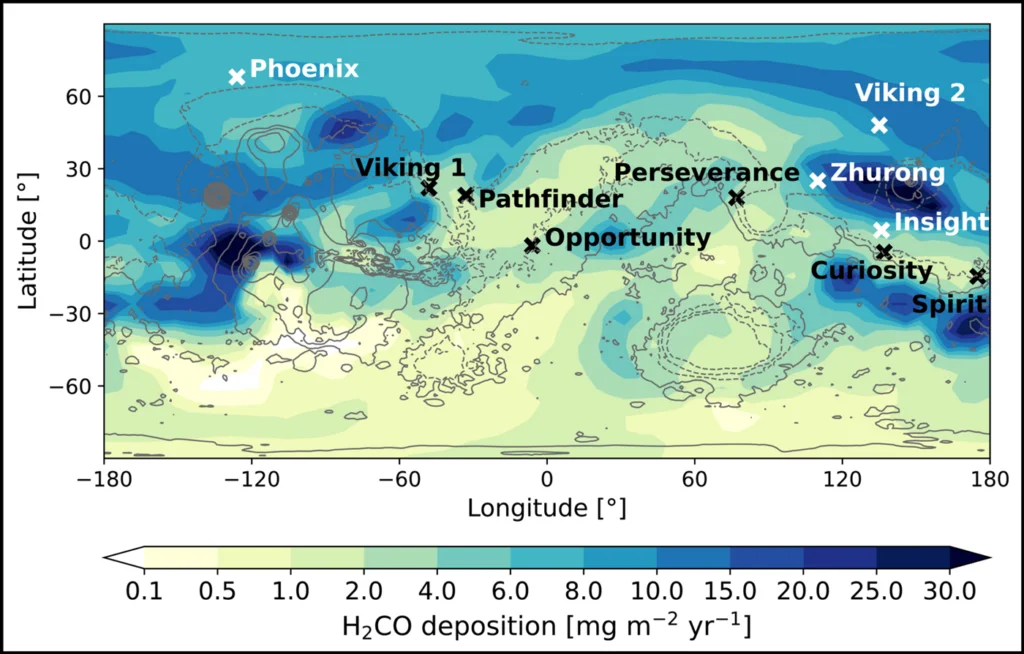
The resulting map shows formaldehyde delivery several times greater in the northern hemisphere than in the south. The modeled northern ocean and Lake Hellas stood out as wet regions where atmospheric concentrations were high. Yet the strongest surface deposits appeared in the elevated terrain of Tharsis and Elysium, at about 10 times the global average.
Koyama said the planetwide delivery varied by roughly a factor of 100. The highland concentrations likely reflect stronger precipitation associated with air rising over slopes and elevated terrain, a process that also intensifies rainfall around mountain ranges on Earth.
The team’s findings appeared in The Planetary Science Journal in September. The map estimates where formaldehyde reached the ground; it does not establish what happened to the molecule afterward or how much organic material it ultimately helped form.
A guide for choosing places to investigate
The broad distribution of modeled formaldehyde suggests that organic-bearing sediments may have formed across more of Mars than previously expected. Yuichiro Ueno, a biogeochemist at Tokyo Institute of Technology who studies early life’s evolution and was not involved in the research, said the results offer a way to assess whether organic matter found by the Curiosity and Perseverance rovers reflects wider availability rather than unusually favorable landing sites.
That interpretation remains to be tested. The model traces atmospheric delivery, while rivers, groundwater, lakes, and ponds could have redistributed formaldehyde after it reached the surface. Wet-dry cycles may also have concentrated it, and later conditions would determine how much resulting organic material survived.
“The hot spots are useful targets for future investigation.”
Koyama’s next questions focus on that journey from atmospheric supply to local chemistry: where water moved the molecule, whether it collected in basins with repeated wet and dry periods, and how much organic matter could persist. Answering them would connect the planetwide map to the conditions needed for prebiotic reactions.
For future exploration, Koyama points to ancient basins near regions with sustained water and high modeled formaldehyde delivery. Those locations could help researchers test whether the ingredients for prebiotic chemistry came together—and guide decisions about where to collect samples.
—Kimberly M. S. Cartier (@astrokimcartier.bsky.social), Staff Writer
This news article is included in our ENGAGE resource for educators seeking science news for their classroom lessons. Browse all ENGAGE articles, and share with your fellow educators how you integrated the article into an activity in the comments section below.


Discussion
Sign in to join the discussion.