Hubble’s visible-light images help map Beta Pictoris’s carbon-rich dust tail, which may extend sideways across the sky rather than behind the star.
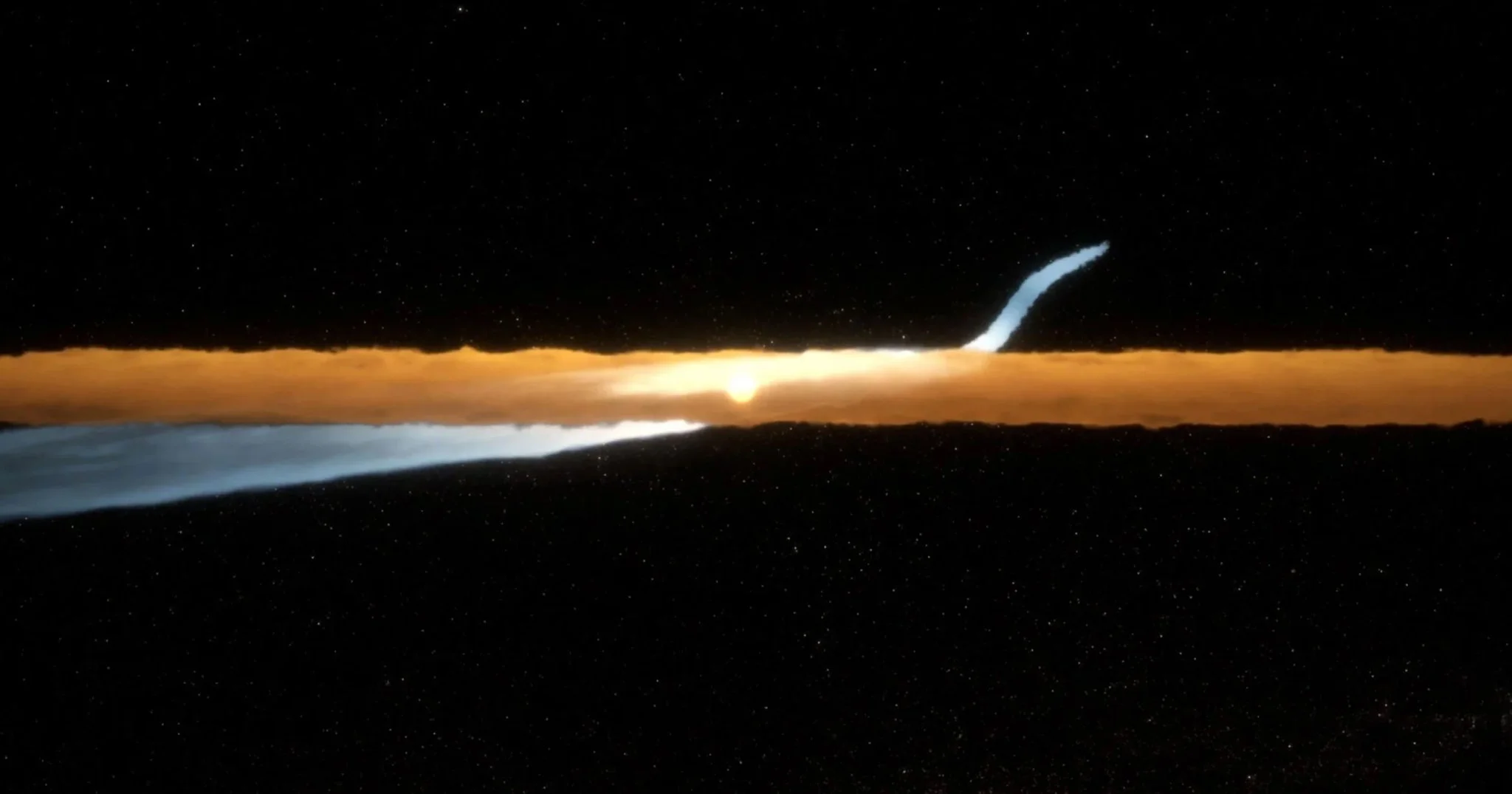
A dust structure seen in a new light
Hubble’s visible-light view of Beta Pictoris’s enormous dust structure changes how astronomers picture its shape. The feature, nicknamed the Cat’s Tail, spans about 1,000 astronomical units, or 93 billion miles, but may stretch sideways across our view of the star system rather than trail far behind it. That distinction matters: a structure’s apparent length in an image doesn’t, by itself, reveal how it’s oriented in space. The new observations offer a way to reconsider what the tail’s striking outline actually represents.
Beta Pictoris lies 63 light-years from Earth. NASA’s James Webb Space Telescope first captured the tail in infrared; new Hubble observations show it in visible light. A University of Arizona team led by doctoral student Arin Avsar combined images from both telescopes to estimate the structure’s geometry in three dimensions. Their findings appeared last month in The Astrophysical Journal Letters.
Each telescope sees a different part of the story. Infrared observations can reveal material that’s hard to pick out in visible light, while Hubble’s view gives researchers another wavelength to compare against Webb’s. The comparison doesn’t provide a direct, three-dimensional photograph, but it can help astronomers test whether a feature that looks elongated in an image is also elongated in the direction they first assumed.
Why the tail escaped visible-light detection
The team points to the material itself. The feature appears to consist largely of organic refractory material rich in carbon. Long chains of carbon atoms absorb visible light, making the dust dark and difficult to detect at shorter wavelengths. In other words, the same composition that may help define the tail could also help explain why it was easier to find in infrared observations.
“Oddly, this feature had previously only been seen with the James Webb Space Telescope, which detects infrared light, but remained invisible at shorter wavelengths, which has puzzled the community for a while,” Avsar said in a statement. “We think the Cat’s Tail has eluded our observations in visible light until now because of what it’s made of.”
The result also shows why a non-detection in one kind of observation doesn’t necessarily mean an object isn’t there. Dust can reflect, absorb, or emit light differently depending on its makeup and the wavelength being observed. When astronomers compare instruments that see different wavelengths, they can sometimes distinguish between a feature’s physical properties and the limits of how it was first observed.
Researchers think collisions between large, Pluto-like bodies produced the dust. The impacts may have heated carbon into vapor, which then cooled into fluffy, porous grains. That explanation could account for both the tail’s composition and its unusual appearance, though the observations describe a proposed origin rather than a direct record of the collisions. The chain of events is plausible as an interpretation; the material itself is what the telescopes are observing.
A different view of its shape
Images in two wavelengths let the team reassess the tail’s orientation. Avsar said it may extend sideways relative to our line of sight, lying mostly in the same plane of the sky as the star and perhaps reaching slightly behind it. That would make its apparent 1,000-unit extent a feature of its projected shape, rather than a long structure stretching directly away from Beta Pictoris.
This is more significant than it looks. A change in the inferred orientation affects how researchers describe the structure and what they consider plausible explanations for its formation. The images still leave room for uncertainty: estimating geometry from observations taken from Earth requires interpreting how material is arranged along our line of sight. The combined views narrow that interpretation, but they don’t turn it into an unambiguous map.
If you’re working in this space, the broader point is that a spectacular image can invite a simple story about shape before the evidence supports one. Here’s the thing: changing the wavelength of observation can change what appears visible, and comparing those views can change how the same feature is understood. And this is the part most people overlook: the tail’s length is an estimate of its apparent extent, not proof that it stretches that far straight out from the star.
The observations also show a warp in the dust halo around the star. The researchers suggest that at least three known planets in the system could be exerting enough gravitational influence to bend the surrounding material. The proposed connection gives the warp a possible explanation in the system’s planetary architecture, while leaving open how the planets’ influence produces the observed shape. A warped halo and an oddly oriented tail offer related clues about the system’s dust, but they aren’t the same feature.
What the system can tell us
At roughly 23 million years old, Beta Pictoris offers a view of a young planetary system. By comparison, our solar system is 4.6 billion years old. The dust, collisions and planetary interactions there may help researchers examine processes that shaped our own system soon after its formation. That comparison is useful as a point of reference, though it doesn’t mean the two systems followed identical paths.
For now, the Cat’s Tail is a reminder that observations can revise a familiar picture without settling every question about what produced it. Hubble’s visible-light detection adds evidence about the dust’s properties; paired with Webb’s infrared view, it also supports a different reading of the structure’s orientation. More detail about its material and geometry could help researchers weigh competing explanations. Still, the main advance here is a clearer set of questions about a feature that had previously been hard to see.
A sideways structure, if that interpretation holds, would also change how the tail is discussed: its remarkable apparent scale would remain, while its relationship to the star would look different. That’s a meaningful shift in description, even if it doesn’t yet explain every step in the tail’s history. Not a final answer.
More on cosmic structures: Scientists Scan Gigantic Structure Hiding Behind Our Galaxy
The post Scientists Intrigued by Incredibly Long Structure Lurking in Nearby Star System appeared first on Futurism.



Discussion
Sign in to join the discussion.