Satellite observations link a bow shock plasma anomaly to enhanced phase scintillation in the polar ionosphere, with implications for navigation and communications.
Editors’ Highlights are summaries of recent papers by AGU’s journal editors.
Source: AGU Advances
Radio signal disruptions in the polar ionosphere may begin far beyond it. A 2026 study by Zhou and colleagues reports a direct link between a hot flow anomaly near Earth’s bow shock and stronger phase scintillation more than 60,000 kilometers away. The finding traces a potential space weather effect on satellite navigation and communications to a short-lived disturbance in hot plasma. That distance is part of what makes the result notable: conditions close to the boundary where the solar wind meets Earth’s magnetic environment may coincide with changes in a region used by radio signals passing overhead. The work offers a specific connection between those distant locations, while leaving open how often this chain of events occurs and how reliably it can be anticipated.
From the bow shock to the ionosphere
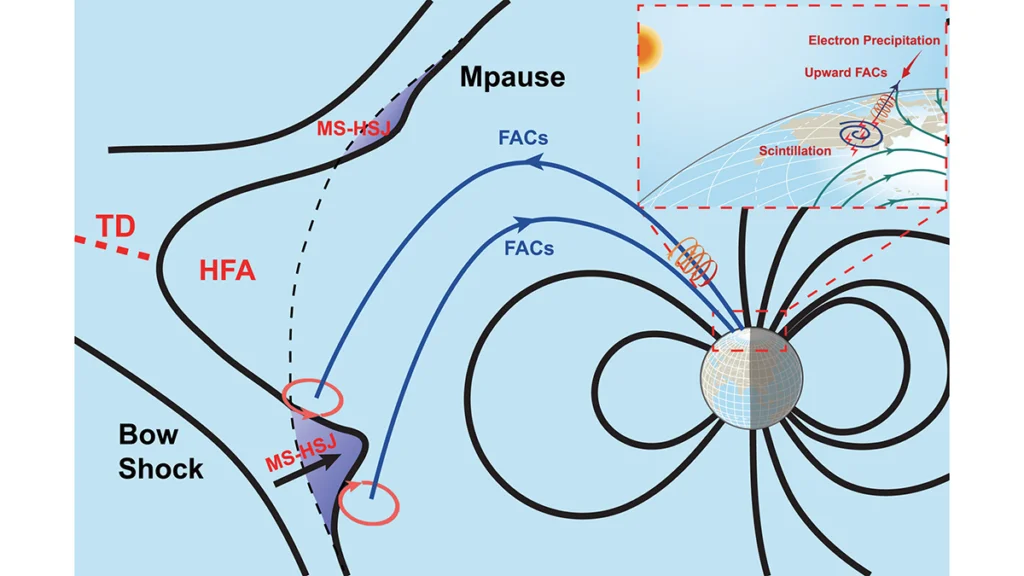
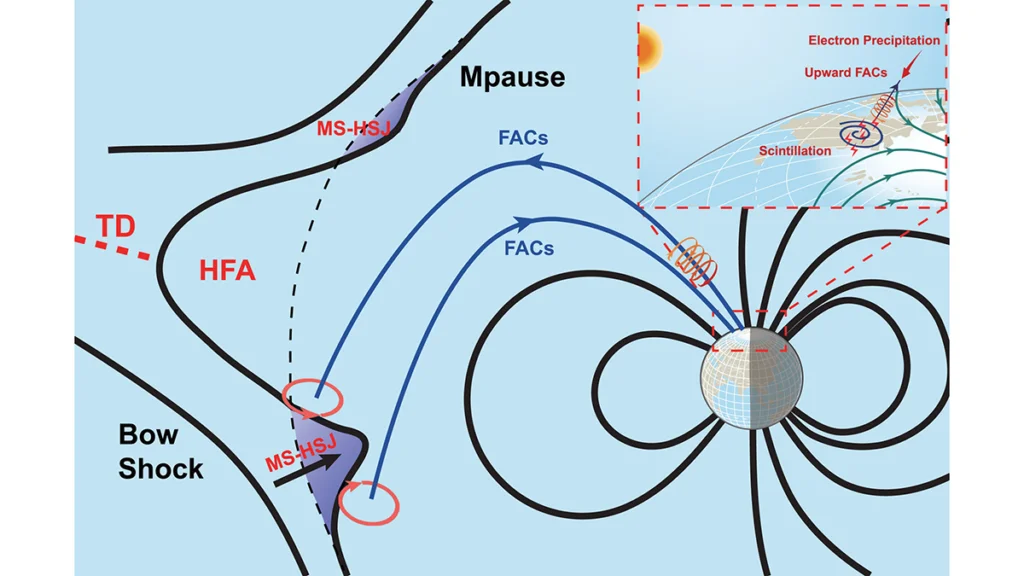
Hot flow anomalies (HFAs) form near the bow shock, where the solar wind slows and bends around Earth’s magnetosphere. They’re localized disturbances in the flow of charged particles, and their short duration can make them difficult to connect to effects farther downstream. Using NASA’s Magnetospheric Multiscale (MMS) satellites, the team measured an HFA alongside energetic charged particles and ionospheric irregularities observed by other satellites and ground-based GNSS receivers. Bringing observations from different parts of the system together matters here: a measurement near the bow shock alone couldn’t establish what was happening in the ionosphere, while a receiver’s signal record couldn’t identify the upstream disturbance on its own.
The observations connect the HFA to a localized increase in phase scintillation in the polar ionosphere. Small-scale irregularities in electron density can bend and diffract radio waves, changing their amplitude or phase and disrupting transmission. Phase scintillation describes changes in the phase of a received radio signal; it’s a different measure from changes in signal strength, though both can reflect a disturbed path through the ionosphere. The effects can reach satellite navigation systems such as the Global Navigation Satellite System (GNSS). For people relying on satellite positioning or communications, the practical concern is that a signal can be affected by conditions along its route, not only by the satellite or receiver.
This is more significant than it looks. A distant association between an upstream plasma event and a change in radio propagation gives researchers a way to examine how energy and particles move through the coupled space environment. It doesn’t, by itself, show that every HFA produces scintillation, or establish the size of the disruption for any particular user. The report describes a measured case, and that distinction matters when translating a scientific observation into expectations about system performance.
A chain of linked processes
The HFA coincided with a vortex in ion convection, auroral electrons, and stronger electrical current flowing along the magnetic field. The authors suggest these processes carried the disturbance into the polar ionosphere, where they produced localized irregularities and the resulting phase scintillation. In this account, the HFA is not simply a remote marker that happened to appear at the same time as a radio effect. It may be part of a sequence in which particle activity and currents connect the disturbance near the bow shock to changes in the ionosphere. The measurements offer a clear case of how a plasma event near the bow shock can affect radio signals far away.
The wording “coincided with” is important. The observations show the processes occurring together, and the authors propose a pathway linking them; a single event can’t settle every question about cause, timing, or how broadly the mechanism applies. Similar systems typically involve interacting flows, particles, and magnetic fields, so separating one pathway from other influences takes more than a striking alignment. Here, the value lies in the combined measurements and the plausible physical sequence they support. And yet, the account doesn’t turn that sequence into a ready-made forecast.
There’s also a practical measurement challenge. Ground-based GNSS receivers observe signals after they have crossed the ionosphere, while satellites can record conditions at different points in space. Comparing those records can help researchers locate where a disturbance is occurring and relate it to upstream conditions. But observations from multiple instruments need to line up in place and time before a chain of events can be argued with confidence. (And this is the part most people overlook.) The coordination needed to make such comparisons is itself a limit on what can be inferred from any one observation.
What the finding could mean
For space weather research, the study points toward a wider view of radio disruptions: conditions far from the ionosphere may be relevant to what receivers experience beneath it. If you’re working in this space, the useful question isn’t only whether scintillation occurred, but which upstream conditions and intermediate processes accompanied it. That perspective could help guide future observations and comparisons across instruments. It won’t establish a prediction method on its own, but it gives researchers a concrete event and a proposed physical link to examine.
The potential relevance to navigation and communications is clear, but the article doesn’t quantify service impacts or say how frequently this particular pathway operates. Readers should treat the result as evidence of a connection in the observed case, not a measure of routine risk. For system operators, the broader implication is that ionospheric signal conditions can reflect activity across a much larger region of near-Earth space. The next question is whether similar linked measurements can identify a repeatable pattern, and whether that pattern could improve understanding of when polar radio signals are most vulnerable.
The authors’ proposed chain is a useful framework for asking that question. More observations would be needed to show how the relationship varies across events and conditions, and whether the same combination of convection, energetic particles, and field-aligned current repeatedly accompanies stronger phase scintillation. Until then, the study’s strongest contribution is specific: it links a measured HFA with ionospheric activity and a localized radio signal effect across a substantial distance. A promising connection. Not yet a general forecast.
Citation: Zhao, J.-C., Zhang, Q.-H., Yang, Z.-W., Zhang, D., Oksavik, K., Wang, B.-Y., et al. (2026). Ionospheric scintillation induced by hot flow anomalies via particle precipitation. AGU Advances, 7, e2026AV002548. https://doi.org/10.1029/2026AV002548
—Andrew Yau, Editor, AGU Advances


Discussion
Sign in to join the discussion.