NASA’s Blue and Gold probes head for Mars in November, carrying new magnetotail observations and a two-spacecraft plan to track atmospheric escape.
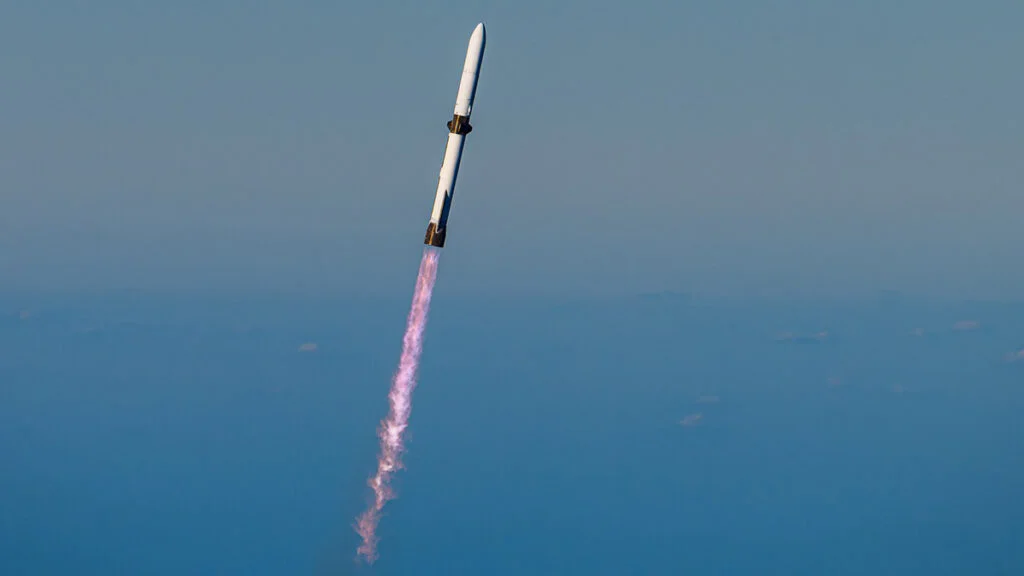
ESCAPADE’s route to Mars has already produced science that no previous mission could collect so far from Earth. Now the twin spacecraft are scheduled to leave their extended orbit near Earth in early November, beginning a journey to study how the solar wind interacts with Mars and helps carry material away from its atmosphere.
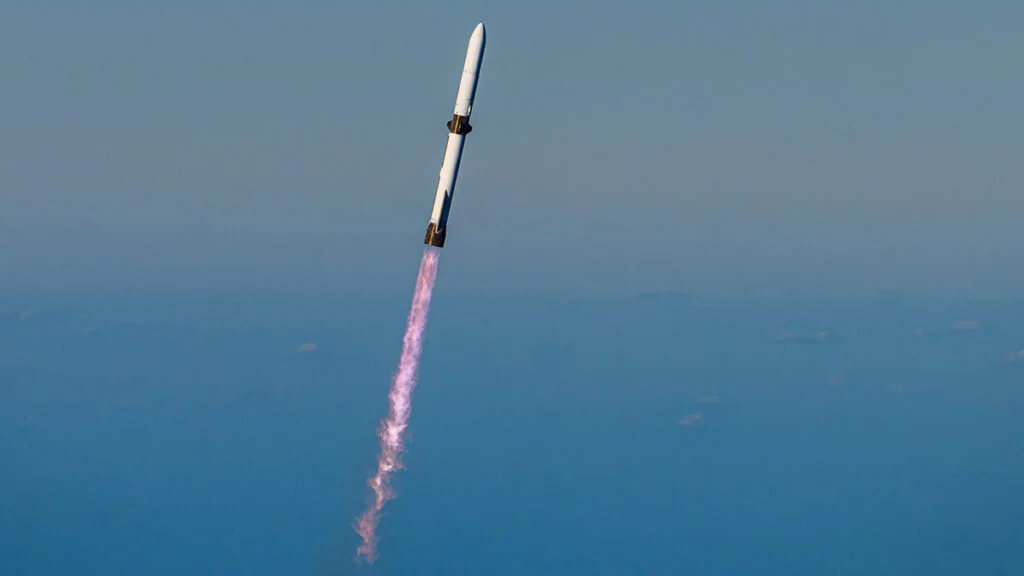
The NASA mission, formally called ESCAPADE—Escape and Plasma Acceleration and Dynamics Explorers—pairs two small, identical probes named Blue and Gold. They launched on 13 November 2025 aboard the second New Glenn booster. Rather than continue directly toward Mars, the spacecraft entered a planned holding orbit while Earth and Mars moved into a suitable alignment. Their arrival at Mars is expected next September.
The departure sequence starts with Blue on 7 November, when it reaches its closest point to Earth. The probe will burn its engine for 9.5 minutes, then use Earth’s gravity for an additional push toward Mars. Gold will repeat the maneuver two days later. The instruments measuring magnetic fields, charged particles, and extreme-ultraviolet radiation from the Sun are expected to operate through most of the cruise.
A detour with scientific value
The schedule reflects a mission that had to be redesigned more than once. ESCAPADE was originally slated to travel with NASA’s Psyche asteroid mission in 2022, on a trajectory that would have taken the probes directly to Mars. When Psyche moved to a different launch vehicle, ESCAPADE was reassigned to the first flight of Blue Origin’s New Glenn. Technical problems then forced another change.
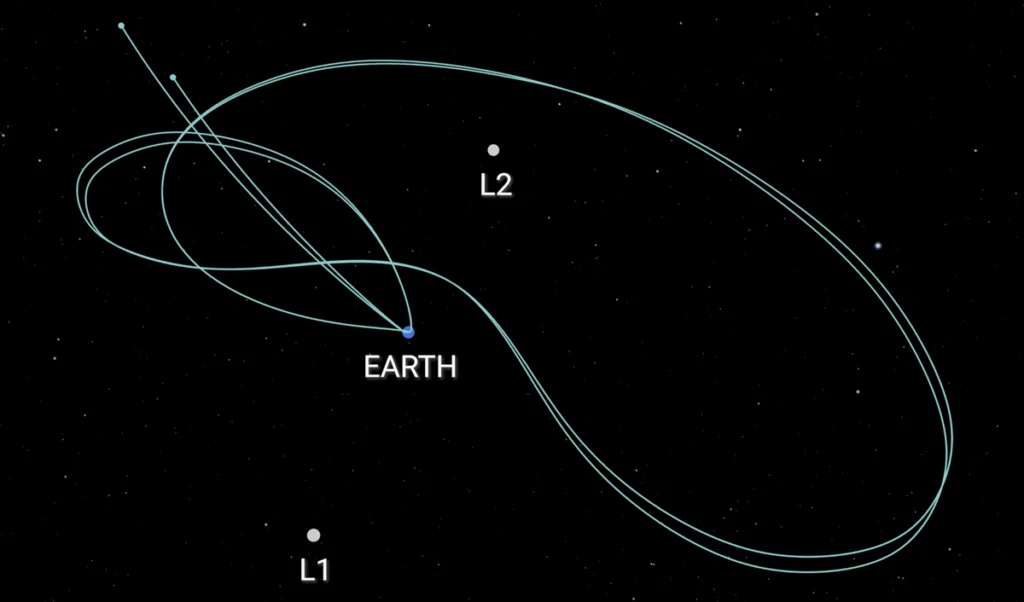
The team devised a route that could launch on New Glenn’s second flight and hold the probes near Earth until the timing worked. After launch, the spacecraft followed a broad, looping orbit around L2, the second Earth-Sun Lagrange point. At roughly 1.5 million kilometers from Earth on the side opposite the Sun, L2 is a region where the gravitational pulls of Earth and the Sun balance. The unusual wait has made it possible to observe a part of Earth’s space environment that had never been explored at this distance.
“Fortunately, we have an incredible team,” said Shannon Curry, ESCAPADE’s project scientist and an associate professor of astrophysics and planetary science at the University of Colorado Boulder. “They sat down, sharpened their pencils, and worked out a way to make it happen.”
Two probes at the edge of Earth’s magnetic environment
“The most exciting thing is they transited through Earth’s distant magnetotail—a never-before-explored region. They got a unique set of observations that will be discovery-level science.”
The spacecraft’s detour took them about 2 million kilometers into Earth’s magnetotail, several hundred thousand kilometers farther than any earlier mission, according to Robert Lillis, ESCAPADE’s principal investigator and associate director of the Space Sciences Laboratory at the University of California, Berkeley. The magnetotail forms as the solar wind stretches Earth’s magnetic environment into a long teardrop shape, extending millions of kilometers away from the Sun.
The two spacecraft gave researchers a way to compare conditions at different points in that distant tail. Lillis said they examined how the solar wind and interplanetary magnetic field deform and compress the structure. Their observations also helped researchers estimate the tail’s size and twist, and track how it contracts when solar-wind pressure rises. Analysis is continuing.
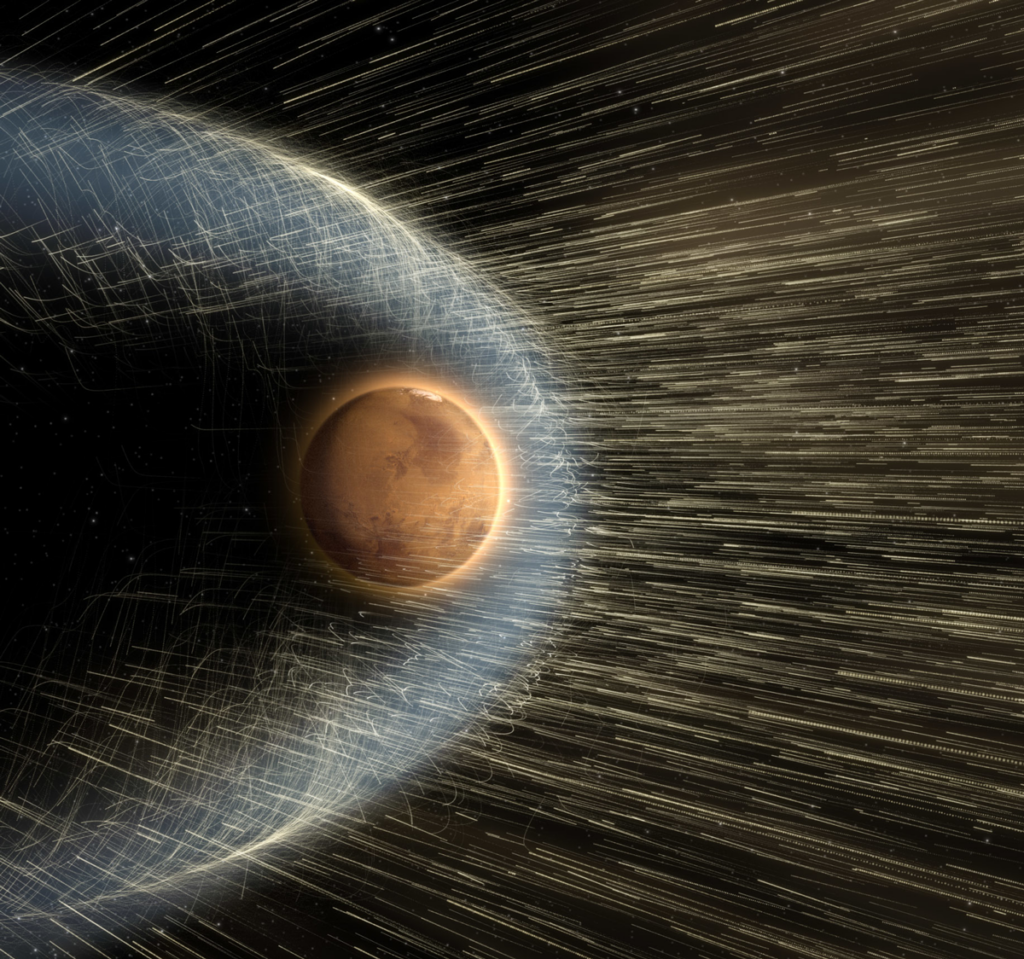
The same two-probe approach will be applied at Mars, where the mission’s central question is how the planet lost so much of its atmosphere and surface water. Mars was once warmer and wetter, but most of its air and surface water disappeared billions of years ago. One leading explanation connects that loss to the shutdown of Mars’s internal dynamo, which generated a global magnetic field. With that protective field gone, solar particles could erode the upper atmosphere.
Watching atmospheric escape in real time
After reaching Mars, Blue and Gold will spend several months adjusting their orbits. During the first science phase, they are expected to follow matching elliptical paths in a “string of pearls” formation. Their spacing will vary as they orbit, ranging from about 2 to 30 minutes apart. That arrangement lets them sample the same region of Mars’s magnetosphere in succession and distinguish changes over time from differences across space.
A single spacecraft can observe changes in its surroundings as it moves around Mars, but those measurements are tied to the time it takes to complete an orbit. ESCAPADE’s paired measurements should let scientists track how the system changes across a wider range of timescales. “Now we’ll have a unique opportunity to understand how this system varies on a range of timescales that we’ve never investigated before,” Lillis said.
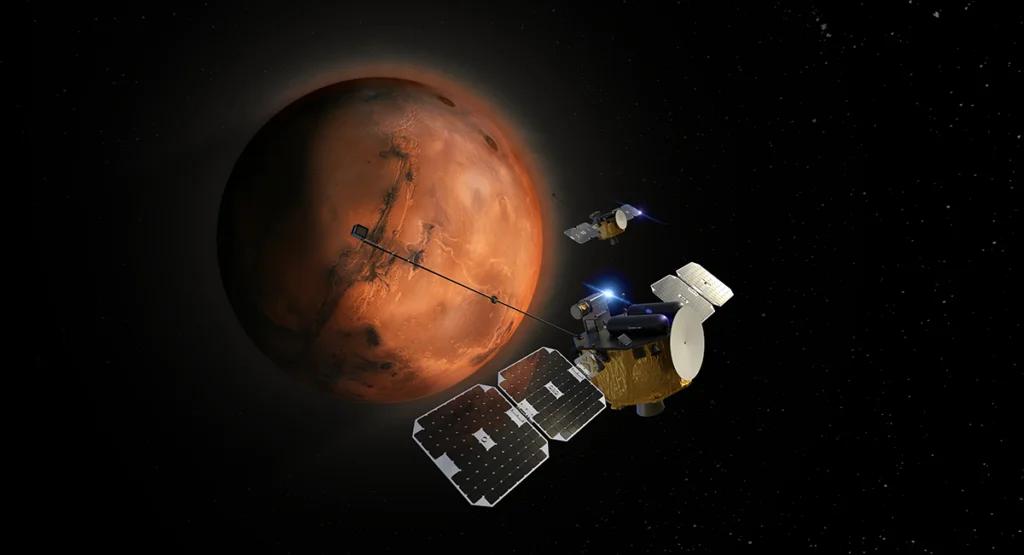
About six months into the mission, the spacecraft will change altitude and spread farther apart. Curry described the intended view as one probe ahead of Mars, observing incoming solar conditions, while the other measures how the atmosphere and magnetosphere respond. “It’s the first time we can see this response in real time,” she said.
That timing matters most during solar storms. Curry said storms may have been a major source of atmospheric erosion roughly three to three-and-a-half billion years ago, when the Sun was more active and produced more storms. ESCAPADE is designed to observe a storm and the resulting atmospheric escape at the same time, tracking how particles are accelerated away from Mars.
“This is a huge piece of the puzzle when we think about Mars habitability.”
The mission won’t directly reconstruct every step of Mars’s ancient climate history. Its value is in measuring the present-day process closely enough to improve scientists’ picture of how atmospheric loss works. Those observations can help constrain how space weather may have depleted the planet’s atmosphere when its magnetic field was gone, and inform estimates of where its former water went.
For Curry, the payoff is a better connection between solar activity and the conditions that shaped Mars’s habitability. ESCAPADE’s next chapter begins with the November departure burns; its paired measurements at Mars will test whether watching the cause and response together can fill a long-standing gap in the planet’s history.
—Damond Benningfield, Science Writer


Discussion
Sign in to join the discussion.