Since October 2023, Perseverance’s onboard planner has adapted schedules to real conditions, reducing idle time and energy use while enabling more science.

Perseverance’s autonomous planner has turned schedule slack into something Mars missions rarely have: time for extra science. Since it began running onboard operations in October 2023, the software has adjusted the rover’s plans to match actual conditions and activity durations, helping it spend less time idle and less energy keeping instruments warm. That sounds like a modest operational gain. On a mission where every activity competes for time and power, it changes what scientists can ask the rover to do.

NASA launched the Mars 2020 mission in July 2020. Perseverance landed in Jezero Crater in February 2021, at a site chosen because its ancient lake and river delta might preserve evidence of past life. For its first two-plus years on Mars, the rover followed plans written on Earth using conventional software. The ground team had to decide in advance when activities would happen, despite not knowing exactly how long each would take or what conditions the rover would encounter.
That changed on 5 October 2023, when Perseverance began using the On Board Planner (OBP). It can respond to the rover’s current circumstances and revise the schedule as work unfolds. The result, according to the mission team, has been a significant reduction in idle time and more thorough investigations at sites of interest, alongside lower energy use for instrument preheating.
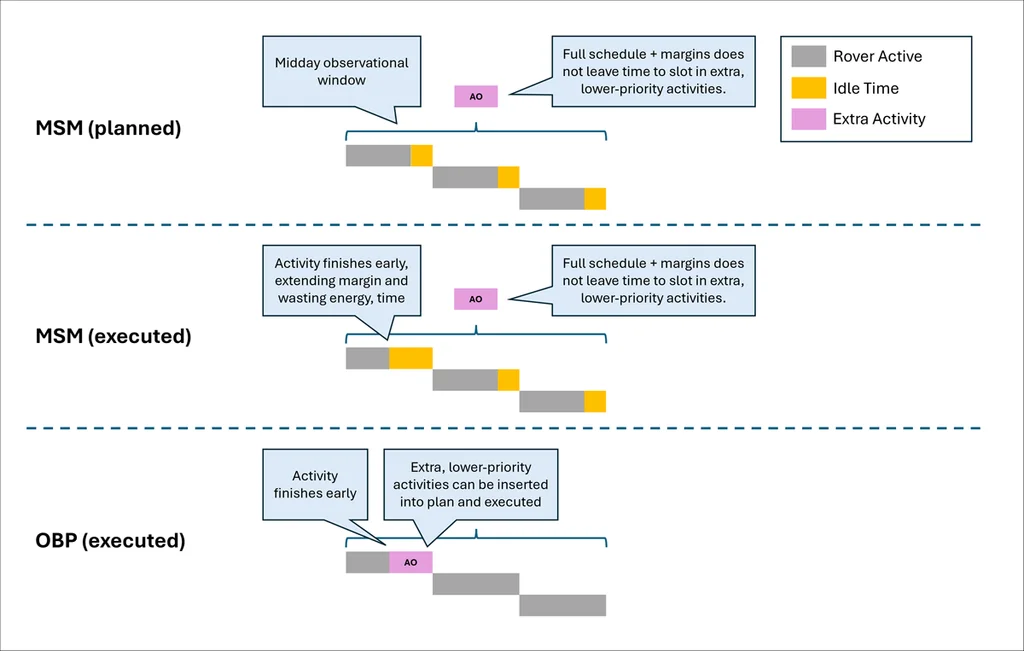
The underlying problem is straightforward: Martian surface conditions and their effects on instruments are hard to predict. Under the conventional master-submaster (MSM) approach, planners built extra time and energy into schedules to protect later activities from delays in instrument preparation or data collection. That buffer reduced the chance that one overrun would disrupt the rest of the day. It also left Perseverance waiting, when it might have been observing, driving, or sleeping to conserve power.
Since switching to On Board Planner (OBP)–run operations, Perseverance has reduced its idle time significantly.
There was a precedent for reclaiming that lost time. A 2016 study by Gaines et al. found that Curiosity, Perseverance’s predecessor, could raise its activity by as much as 30% by using feedback from the rover itself to cut idle periods and unnecessary heating. OBP extends that idea to Perseverance. AI is already used in science on Earth; putting it in charge of a one-of-a-kind planetary rover is a notable step toward more autonomous space operations.
A planner that adapts to the rover
OBP is not a machine-learning model or a large language model. It uses constraint reasoning and search protocols to build schedules [Johnston and Miller, 1994; Chien et al., 2010]. That older, more structured approach has a practical advantage in a high-stakes setting: engineers can target their analysis and tests, and the software can explain the reasoning behind its choices. Operations staff can inspect how it is likely to behave across different situations, which helps them decide whether to trust its plans.
The OBP can access information about the real-time state of the rover and its environment, conditions that are hard to predict when planning the rover’s activities from Earth.
On an average Martian day, or sol, OBP replans more than 15 times. It starts with activities the ground team wants completed, then fits them around the rules that govern safe and useful operation. Some observations need particular lighting. An instrument mounted on the robotic arm can’t be used until the arm has been unstowed. Instruments and mechanisms may need warming before they can work in the cold Martian air.
The planner also receives current readings, including battery charge and ambient temperature. That matters because a schedule made on Earth can only estimate those conditions. OBP can add, remove, or adjust activities as the actual situation becomes clear, while honoring the mission’s science goals and safety limits.
Recovering time, energy, and observations
Under MSM, the ground team usually scheduled activities a day or more ahead at fixed times. It had to reserve margins in case an activity ran long, so the rover could end up waiting even when work finished early. OBP can let the next activity start sooner, finish the day’s plan ahead of time, and use the remaining time for more work or an early sleep period.
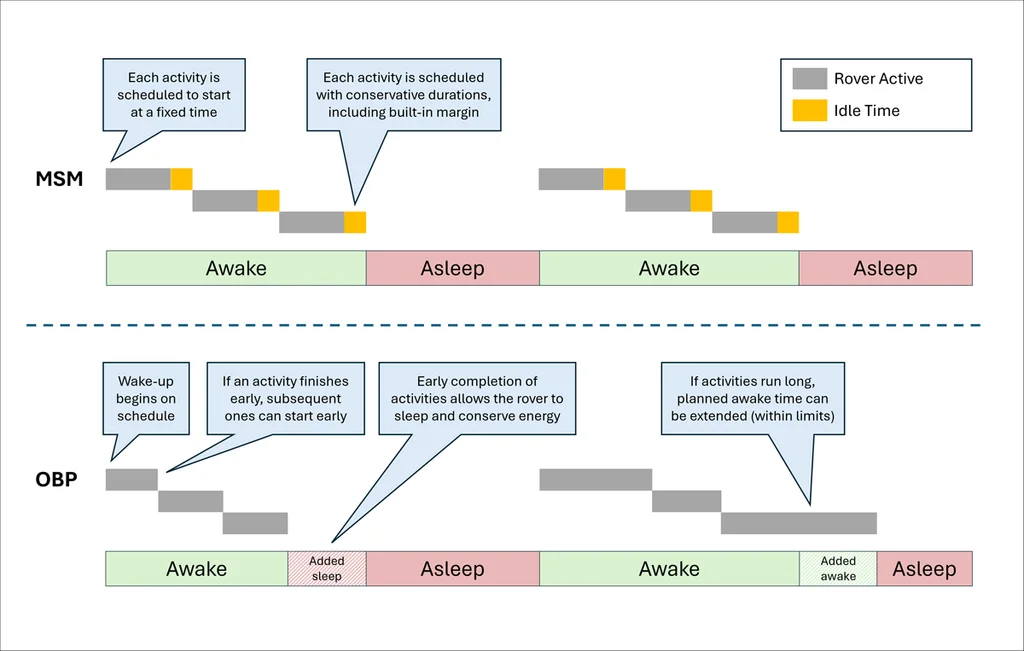
It can also react when work takes longer than expected, including canceling an activity if keeping it would threaten more important tasks later in the schedule. That flexibility gives planners a way to protect priorities without treating every delay as a reason to abandon the rest of the day.
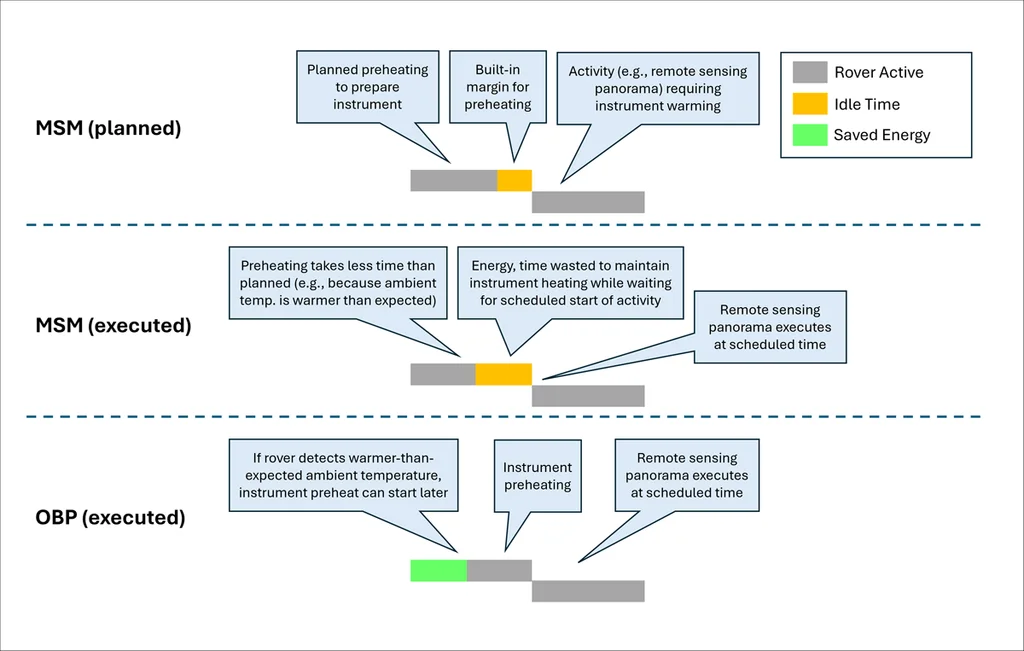
Temperature feedback offers another source of savings. In MSM operations, the team scheduled energy-intensive “open-loop” preheating from predicted temperatures, without adjusting the plan using rover sensor readings. OBP can wait longer to start heating when the air is warmer than expected. A 2026 study reports that this approach has increased available rover energy by more than 10% [Gaines et al., 2026].
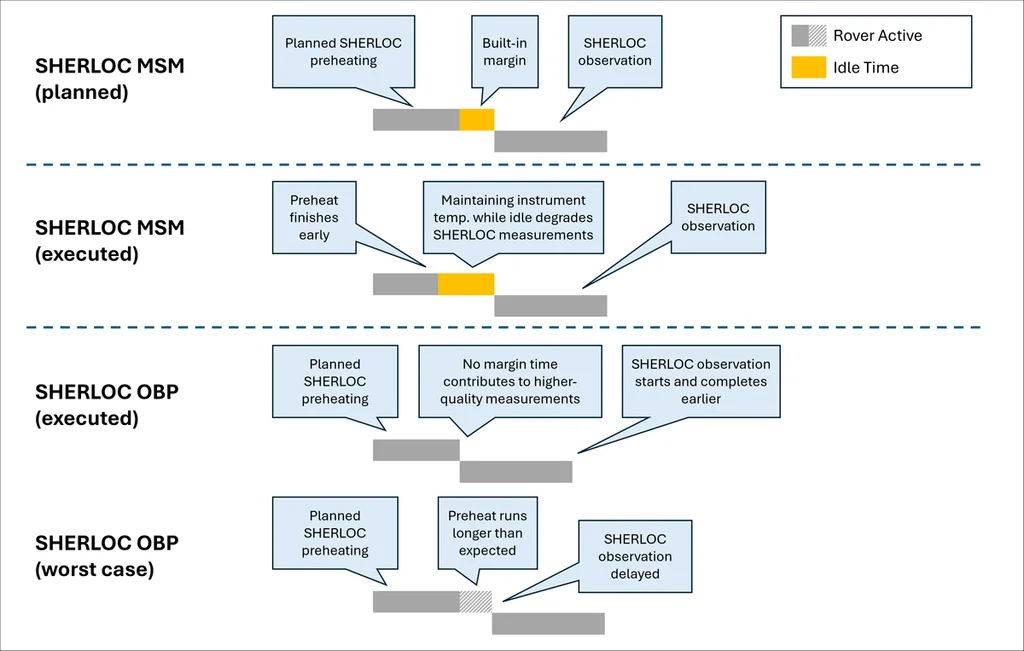
Heating is also a science-quality issue. Perseverance’s laser-equipped SHERLOC spectrometer—Scanning Habitable Environments with Raman and Luminescence for Organics and Chemicals—detects mineral and organic signatures. It needs to warm up, but keeping it hot longer than necessary adds heat that can introduce noise and affect calibration. OBP can use a best estimate of the required preheat time instead of a longer, more conservative allowance. If warming does take longer, it can delay later activities rather than cancel them outright.
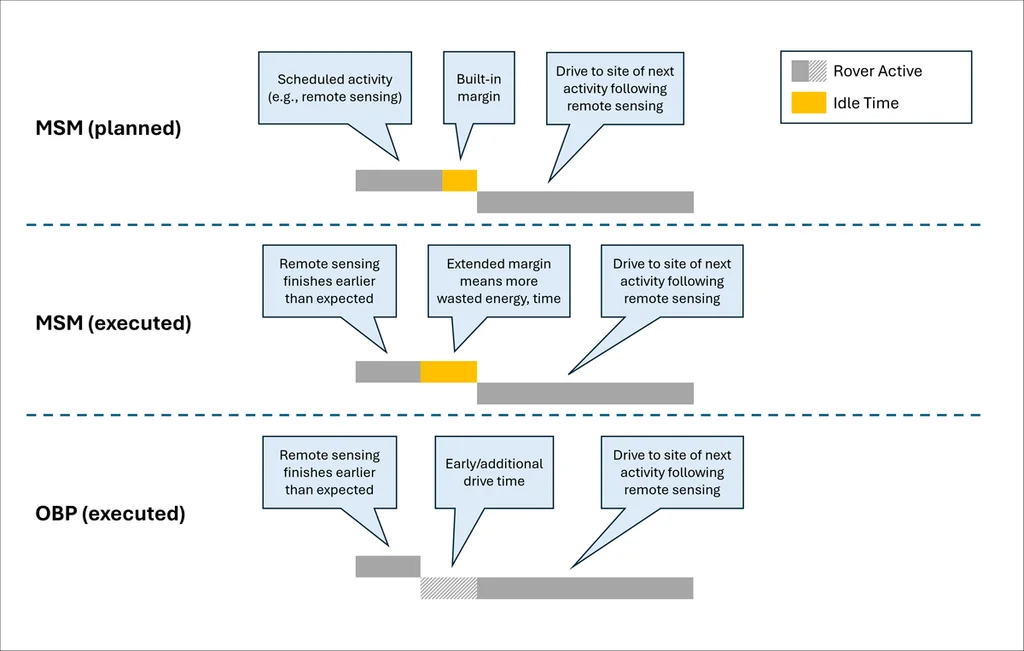
When an activity ends early and the next task is a drive, the rover can use the spare time to start moving. Across a long traverse, those small gains can shorten the trip between regions of interest and leave more time for science. OBP can also fit in optional work: when high-priority midday tasks such as driving, geological imaging, and spectroscopy finish early, the rover may be able to collect lower-priority atmospheric measurements that otherwise would have been dropped.
More room for science at Bright Angel
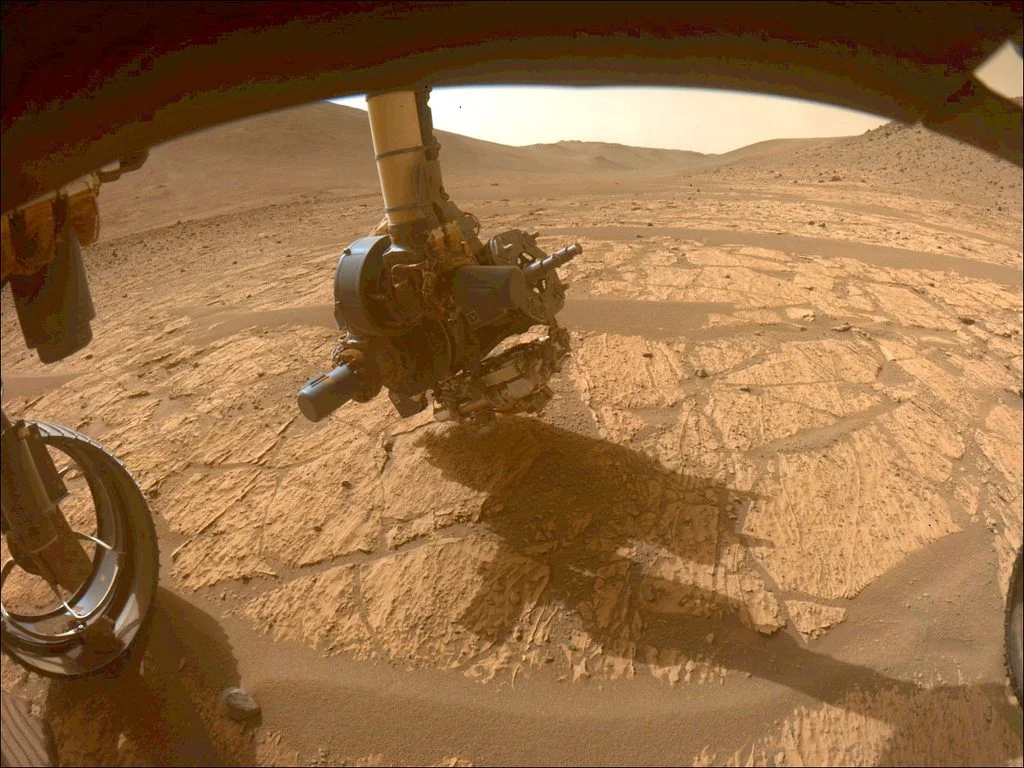
The benefits became tangible during Perseverance’s 42-sol campaign at Bright Angel in 2024, covering sols 1,177–1,219. The rover found Cheyava Falls, a rock marked with leopard-like spots, and collected a sample named “Sapphire Canyon.” The sample is sealed for possible retrieval along with others gathered by the rover.
Sapphire Canyon contains features that may help answer whether Mars once supported microscopic life. Researchers reported evidence of past redox reactions, organic carbon, and iron phosphate and sulfide minerals arranged in millimeter- and submillimeter-scale structures. Those features have been interpreted as potential biosignatures [Hurowitz et al., 2025]. They are suggestive evidence, not a verdict on whether life existed.

The geology around Cheyava Falls called for extensive investigation. OBP’s energy savings and scheduling flexibility let the science team add observations beyond its initial plan: more spectrometer measurements and imaging before collecting Sapphire Canyon, plus a drive to inspect another part of Bright Angel. Those are energy-intensive tasks, and MSM schedules made last-minute additions difficult.
Under conventional programming, energy-intensive activities could not be accommodated on short notice. With OBP, the team found itself far less constrained in adding or swapping out planned activities.
After drilling the sample, the team also chose to run an extended set of SHERLOC observations on Cheyava Falls. Under MSM, fitting them in would have meant waiting one or two sols to recharge, forcing the team to weigh their value against a significant delay. But the sample drilling took less time than expected, and OBP had conserved enough energy for the measurements to happen immediately.
The extra SHERLOC work covered more of the area and improved the statistical strength of the observations. That helped shape the team’s interpretation of the possible biosignatures in Sapphire Canyon and increased its confidence in that interpretation. The case for onboard planning is practical: better use of time and power can change which scientific questions a rover gets to pursue.
Perseverance’s Onboard Planner (OBP) matters because it coordinates the rover as a whole. Other AI systems handle narrower jobs: enhanced navigation (Enav) supports autonomous driving; Autonomous Exploration for Gathering Increased Science (AEGIS) selects targets for the SuperCam instrument [Verma et al., 2023]; and an adaptive sampling algorithm guides the Planetary Instrument for X-ray Lithochemistry (PIXL) X-ray fluorescence spectrometer [Lawson et al., 2025]. OBP’s remit is broader: it schedules activity across the rover system.
Perseverance cost billions of dollars to build and send to Mars, and there is no second rover waiting in reserve. OBP was built to meet an exceptionally high reliability bar.
Since October 2023, OBP has operated almost continuously. By September 2026, it had completed more than 450 tactical planning cycles over more than 1,000 sols. It is expected to keep directing rover operations for the rest of the mission.
Getting software with that responsibility into service required more than proving it could produce a plan. The operations team first ran a ground-based version for over a year, gaining experience with its capabilities. That version could also explain its decisions, giving staff a way to see how the planner might behave aboard the rover.
Instrument teams also worked through their operating procedures with rover staff. Those discussions changed a long-established assumption: instead of assigning each activity one fixed execution time, teams specified an acceptable time window based on science and safety needs. OBP could then place the activity within that window.
The mission team followed those preparations with a progression of increasingly realistic operational walkthroughs. Ground readiness tests and three tests on the flight vehicle checked the system in practice. A “flight school” taught most of the operations team how OBP works and what autonomous planning feels like day to day. Together, the training and testing helped make the switch from the Mars Science Manager (MSM) to OBP a smooth one.
What Perseverance’s experience means for future missions
OBP is a landmark use of AI on a major planetary mission, but its wider value may lie in the operating lessons it leaves behind. Teams building future robotic explorers on Earth or elsewhere can draw on the work of making a major AI capability acceptable to a mission, then developing, verifying, validating, and deploying it. Possible missions such as the Uranus Orbiter and Probe and the Endurance lunar rover are among the concepts that could benefit.
OBP’s successful deployment gives researchers a working example of how AI can support robotic explorers on Earth and beyond.
For that approach to work, everyone involved—from science and instrument specialists to robotics teams—needs to understand what latitude OBP has. It can shift the timing of activities and, in some cases, change what gets done. Teams must be able to describe the flexibility each activity allows. Operations engineers, meanwhile, need tools to forecast the range of plans OBP might produce and to inspect afterward what it chose and why. That visibility is part of operating safely while still pursuing the science.
Human oversight remains central to Perseverance’s strategic science and operations decisions. More distant destinations could make that arrangement harder to sustain: communications would be more limited, mission windows shorter, and environments less familiar and more extreme. A Europa Lander concept and the Exobiology Extant Life Surveyor (EELS) concept for the surface of Enceladus would therefore need AI to take on more decisions and weigh risk against reward with less human supervision. Both concepts have prototyped systems for that purpose. The proposed Enceladus Orbilander could also benefit from a similar approach.
Those missions remain concepts, and their eventual designs may differ. Still, if they fly, the methods used to put OBP on Perseverance will be part of the foundation for the systems that guide them.
Acknowledgments
This research was conducted at the Jet Propulsion Laboratory, California Institute of Technology, under NASA contract 80NM0018D0004.
References
Chien, S., et al. (2010), “Timeline-based space operations scheduling with external constraints,” Proceedings of the International Conference on Automated Planning and Scheduling, 20(1), 34–41, https://doi.org/10.1609/icaps.v20i1.13410.
Gaines, D., et al. (2016), “Productivity challenges for Mars rover operations,” in Proceedings of the 4th Workshop on Planning and Robotics (PlanRob), pp. 115–125, London, https://ntrs.nasa.gov/citations/20190025594.
Gaines, D., et al. (2026), “The Mars 2020 OnBoard Planner—Increasing mission productivity of the Perseverance rover,” Science Robotics, www.science.org/doi/10.1126/scirobotics.aeh2947.
Hurowitz, J. A., et al. (2025), “Redox-driven mineral and organic associations in Jezero Crater, Mars,” Nature, 645, 332–340, https://doi.org/10.1038/s41586-025-09413-0.
Johnston, M., and G. Miller (1994), “Spike: Intelligent scheduling of Hubble Space Telescope observations,” in Intelligent Scheduling, chapter 14, edited by M. Fox and M. Zweben, Morgan Kaufmann, San Mateo, Calif.
Lawson, P. R., et al. (2025), “Adaptive sampling with PIXL on the Mars Perseverance rover,” Icarus, 429, 116433, https://doi.org/10.1016/j.icarus.2024.116433.
Verma, V., et al. (2023), “Autonomous robotics is driving Perseverance rover’s progress on Mars,” Science Robotics, 8(80), eadi3099, https://doi.org/10.1126/scirobotics.adi3099.
Author Information
Steve Chien ([email protected]), Raymond Francis, and Dan Gaines are with the Jet Propulsion Laboratory, California Institute of Technology, La Cañada Flintridge, Calif.



Discussion
Sign in to join the discussion.