Ground-based optical measurements in Svalbard captured auroral electric field changes that may reflect electrons bouncing off Alfvén waves.
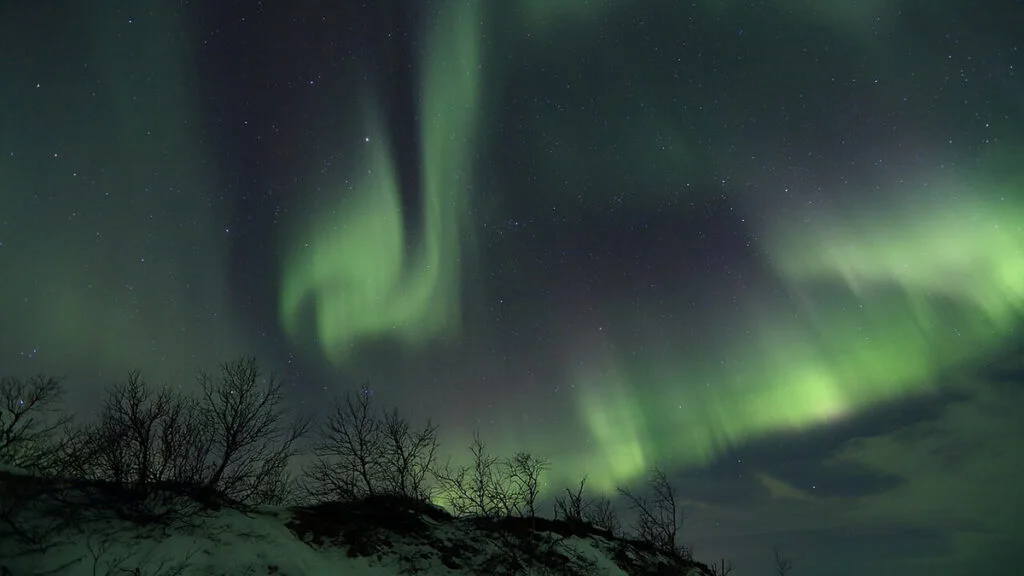
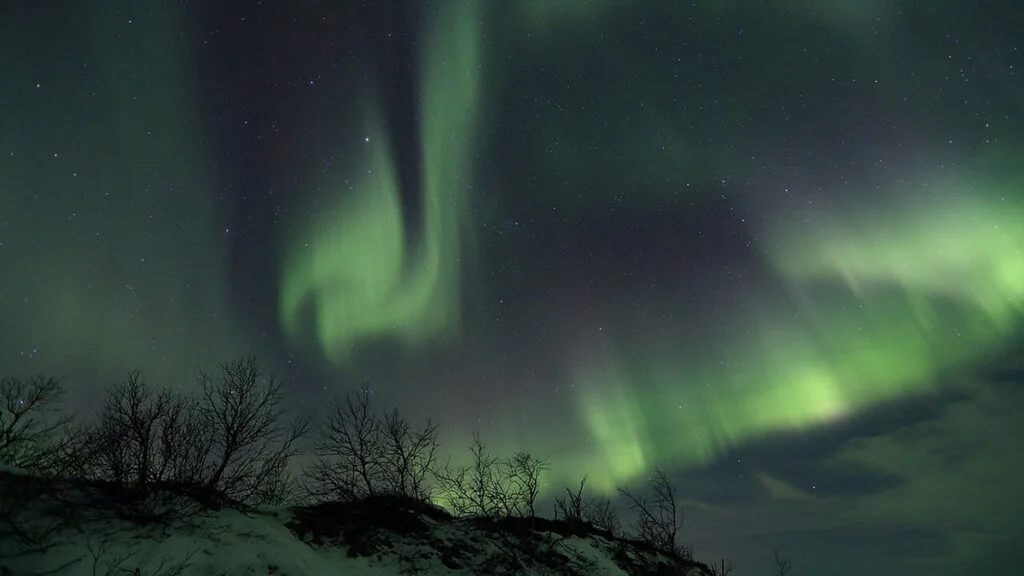
Source: Journal of Geophysical Research: Space Physics
Reading electric fields in auroral light
Fine details in auroras may reveal how electrons interact with waves high above Earth. Brindley and Whiter combined high-resolution optical observations with a mathematical model to examine small-scale changes in electric fields. Their analysis found that some discrepancies between measurement methods could arise when electrons bounce off Alfvén waves above the ionosphere. That possibility matters because the light we see is not just a record of particles hitting the atmosphere; its changing pattern can also carry clues about the processes that shaped those particles on their way down.
The researchers aren’t claiming that every mismatch has a single explanation. Their proposed mechanism offers one way to account for differences between field maps, while leaving the underlying measurement challenge visible. Electric fields in auroral regions are difficult to reconstruct because observations capture only part of a dynamic system: the instruments record emissions, and researchers use models to infer the conditions that produced them. A disagreement between two maps can therefore point to limits in the assumptions, missing physical effects, or both. Here’s the thing: that uncertainty is useful when it directs attention to processes the simpler picture may leave out.
Why ground observations add a different view
The work offers a way to study auroral behavior that satellites can miss. Spacecraft observations have identified U-shaped electric potentials above auroral arcs, but a satellite usually passes through a region of interest quickly. That brief crossing gives a direct measurement along a moving path, yet it can make it hard to tell how the same location changes over time. Ground-based observations bring a different strength: they can follow a patch of sky for longer, letting researchers compare changes across a sequence rather than relying on a single pass.
Neither vantage point answers every question by itself. Satellite instruments can sample conditions above the atmosphere, while optical instruments on the ground observe the light produced when energetic particles enter it. Linking those observations requires a physical interpretation of how particles, fields, and emissions relate. A ground-based record can show where and when brightness changes, but it doesn’t directly photograph an electric field. The model supplies that connection, and its assumptions shape what the resulting map can say.
This is more significant than it looks: sustained viewing can turn a fleeting auroral structure into a time series that researchers can compare with physical models. And this is the part most people overlook: longer observation doesn’t automatically mean a complete account. It does, however, give scientists more opportunity to test whether a proposed structure evolves in a way consistent with the measured emissions.
What the ASK observations captured
The researchers analyzed oxygen and nitrogen emissions in optical and near-infrared wavelengths, recorded by the Auroral Structure and Kinetics (ASK) instrument during its deployment in Svalbard, Norway. The instrument captured spatial and temporal changes over 25 seconds, giving the team a view of electric field evolution that brief satellite passes often lack. Oxygen and nitrogen emissions provide observable signals from the upper atmosphere; interpreting their patterns in terms of particle and field behavior is the next step, and it depends on how the observations are related to the model.
That short interval is valuable because auroral structures can change while an instrument is observing them. A map assembled from measurements taken at different moments could blur that evolution, while a time-resolved record gives researchers a better basis for asking whether the inferred field changes along with the emissions. The ASK observations therefore provide more than a still image. They offer a view of how the observed pattern develops, within the limits of the instrument’s coverage and the duration of the record.
Two methods, one unresolved mismatch
They mapped the fields using two methods. One assumed a U-shaped potential, consistent with structures previously observed by orbiting satellites. The resulting maps largely agreed, though some differences remained. The authors propose that electrons accelerated as they bounce off low-frequency Alfvén waves could help account for those mismatches.
Agreement between the maps supports the usefulness of the approach, but the remaining differences are the more revealing part of the result. If the U-shaped potential describes much of the field while failing to explain every detail, an additional process may be needed to account for what the measurements show. The suggested interaction with Alfvén waves provides a candidate explanation. It’s still an interpretation to be examined against further observations, not a reason to treat every small-scale feature as settled.
Similar systems often require researchers to combine observations with models because no single instrument measures every part of the process at once. In this case, the optical record captures atmospheric emissions, while the field structure and electron behavior are inferred. The model makes those inferences testable, but it also means that different assumptions can produce different maps. If you're working in this space, the practical question is whether the proposed wave interaction explains patterns that recur in other observations—not simply whether it can account for one discrepancy.
What finer auroral detail could mean
Auroras form as charged particles from the Sun travel along Earth’s magnetic field and collide with atoms and molecules in the upper atmosphere, producing light. Their motion also offers clues to electric fields in plasma, where charged particles both respond to and generate electromagnetic fields. Reading finer structures in that light could improve study of auroras and other space weather processes. The optical method’s value will depend on how well it can resolve those changes across more observations. (Journal of Geophysical Research: Space Physics, https://doi.org/10.1029/2026JA035658, 2026)
The broader payoff would be a clearer account of how small-scale field structures connect to particle motion and visible emissions. That could help researchers interpret auroral activity as part of a larger chain of space weather processes, while keeping the limits of each measurement in view. The study points toward a method for examining that chain over time. It doesn’t establish how broadly the proposed explanation applies; that depends on how the approach performs across additional observations.
For readers outside the field, the distinction is straightforward: the aurora is the visible signal, while the electric fields and wave interactions are the hidden processes researchers are trying to reconstruct. Better temporal detail can sharpen that reconstruction, but it can’t remove the need to check the model against other evidence. A promising lead. The next test is whether the same kind of mismatch, and the proposed explanation for it, appears in other records.
—Matthew R. Francis (@BowlerHatScience.org), Science Writer



Discussion
Sign in to join the discussion.