Recent research reveals unexpected links between chorus waves and relativistic microbursts, prompting a reevaluation of their interaction and implications.
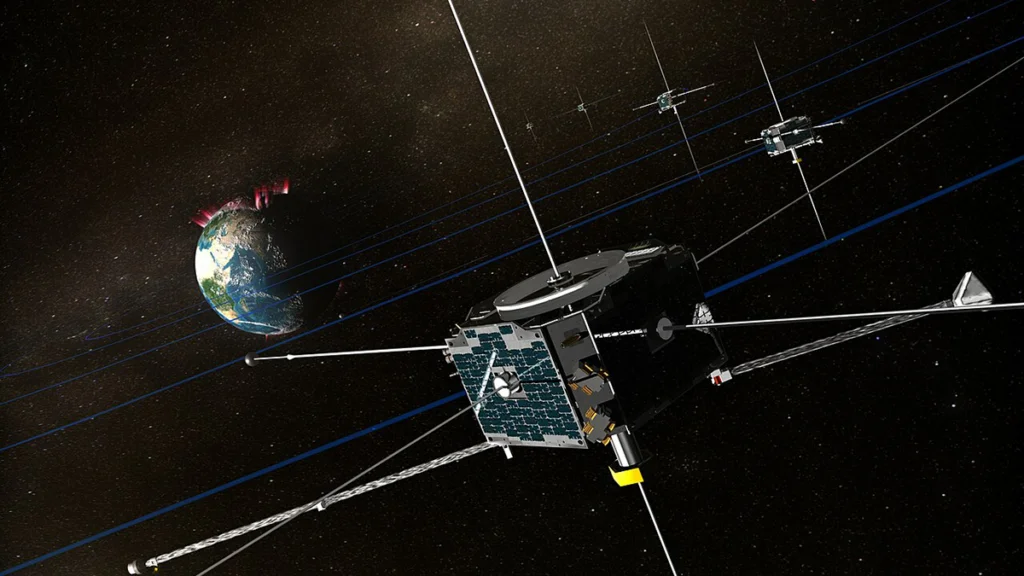
The Van Allen radiation belts are regions filled with energetic charged particles trapped by Earth's magnetosphere, which significantly influence space weather. Their dynamics are vital for assessing potential impacts on satellites, astronauts, and critical infrastructure. Events like geomagnetic storms can cause swift fluctuations in the number of highly energetic electrons within these belts.
Understanding the Van Allen Radiation Belts
Orbiting at altitudes of about 1,000 to 60,000 kilometers above Earth, the Van Allen radiation belts consist mainly of electrons and protons. The inner belt, primarily made of high-energy protons, poses serious dangers to satellites and human activities in space. Meanwhile, the outer belt predominantly contains electrons that are less massive but can accelerate to relativistic (near light speed) velocities. Space weather phenomena, such as solar flares and coronal mass ejections, can alter the dynamics within these belts significantly, which presents immeasurable risks for both manned and unmanned missions in space.
Understanding these belts is increasingly important, as they can affect a range of technology on Earth, including power grids, communications, and GPS systems. If you're working in this space, you’re aware that radiation exposure can also impact the health of astronauts and lead to equipment malfunctions. Thus, a more nuanced understanding of the belts can inform better protective measures and operational protocols for future missions, especially as interest in deep space exploration grows.
The Phenomenon of Relativistic Microbursts
A common phenomenon, known as a relativistic microburst, occurs when trapped electrons discharge into Earth's atmosphere in a brief but intense release. This isn’t just an academic curiosity; understanding these microbursts can have real-world implications, especially since they’re thought to influence radiation-related hazards and atmospheric chemistry. Similar systems typically exhibit discharge patterns that can vary based on numerous environmental factors, so analyzing these events is essential.
The immediate impacts of these microbursts can be felt across various sectors, from aviation to satellite communications. In some cases, they might lead to increased ionization in the atmosphere, affecting radio signals and even resulting in GPS errors. And this is the part most people overlook: the effects are not confined to high-altitude activities but can reach down to ground-based technologies, raising the stakes on accurate predictive models of space weather.
New Research and Its Findings
New findings published by Romero-Minaya et al. challenge existing theories about what instigates these high-energy electron microbursts. The research specifically investigates chorus waves—natural electromagnetic waves that travel through the plasma surrounding Earth. These waves got their name from the characteristic sounds detected by radio receivers, which are indicative of their presence. Such chorus waves have historically been considered the main accelerators of electrons that lead to microbursts, weaving them into the fabric of our understanding of space weather.
The team utilized data from NASA's Time History of Events and Macroscale Interactions During Substorms (THEMIS) and Solar Anomalous and Magnetospheric Particle Explorer (SAMPEX). Their analysis, spanning from June 2010 to November 2012, aimed to identify correlations between chorus wave activity and the occurrence of relativistic microbursts. Given the critical nature of this research, the methodology employed needed to be both rigorous and expansive, separating signal from noise in a sea of chaotic data.
Surprisingly, they found that only a small fraction of chorus waves correlated with microbursts, significantly lower than previously anticipated based on stronger associations suggested by earlier research. This revelation doesn’t just flip assumptions; it prompts reconsideration of the entire risk model surrounding radiation hazards from space. Moreover, the few chorus waves linked to microbursts exhibited higher amplitudes and unique traits, indicating that only a select group of chorus waves might be responsible for driving these high-energy events. Some are questioning the adequacy of existing theoretical frameworks, which may need revision to incorporate these new insights.
Implications for Future Research
This intriguing discrepancy opens new avenues for exploration, with researchers suggesting that further studies are needed to refine our understanding of these dynamics. The implications could reshape how we evaluate risks associated with radiation belt phenomena. For researchers in this field, the question remains: Where do we go from here? Rethinking the role of chorus waves might require new models and simulations, bringing in advanced technology to better capture the nuances of particle interactions.
What's particularly significant is how these findings could influence future space missions by informing the design of spacecraft and satellites. If our understanding of these microbursts evolves, then the parameters for shielding technology and operational protocols must also adapt. This potentially creates a feedback loop: increased knowledge leading to better protection measures, which in turn allows for more ambitious exploration efforts.
As more data pours in, especially from ongoing and future space missions, researchers have the chance to build on this intricate puzzle of cosmic radiation. The world of astrophysics awaits a clearer picture, one that might have repercussions beyond just space exploration, influencing how we understand earthly phenomena too.
(Geophysical Research Letters, https://doi.org/10.1029/2026GL124627, 2026)
—Sarah Stanley, Science Writer


Discussion
Sign in to join the discussion.