Pangram estimated that 90% of Haley Stevens’ post defending her Mike Rogers endorsement was AI-generated; Stevens had not responded.

Haley Stevens’ defense of her decision to endorse Republican Mike Rogers is drawing attention for both its argument and its style. An analysis by AI detector Pangram estimated that 90% of the Michigan congresswoman’s post was AI-generated. That result has circulated as a possible clue about how the statement was written, but it isn’t proof: a detector can flag patterns in text without establishing who drafted, edited, or approved it.
A post defending a sharp political turn
Stevens published the nearly 900-word post, titled “The Decisions We Make,” on X. She used it to explain why she withdrew her support for Democrat Abdul El-Sayed, who had defeated her in the primary months earlier, and backed Rogers for Michigan’s open Senate seat. The shift is consequential because it puts a prominent Democrat behind a Republican in a contest that has become a test of party loyalty as well as a debate over the candidates. The move has angered many Democrats, while Republicans, including President Donald Trump, praised the move.
The race is among the country’s most closely watched midterm contests and could affect control of the Senate. That makes Stevens’ explanation more than a personal account: voters and party supporters have reason to ask what changed, and why her endorsement should carry weight after the primary result. Stevens had already tried to explain her decision in a CNN interview. That appearance drew harsh criticism; one commentator called it “one of the most bizarre and incoherent political interviews I can recall.” A lengthy written post gives Stevens more room to make her case, but it also invites close reading of how that case was put together.
Why the detector raised questions
Pangram’s analysis found the post likely to be 90% AI-generated. Other users who posted their own Pangram results reported similar findings. Those results indicate that the detector recognized patterns it associates with AI writing; they don’t independently verify the drafting process. The detector can make mistakes, but independent testing has found it accurate in most cases. “Most” still leaves room for a mistaken classification, especially when a tool’s score is treated as a verdict rather than an estimate.
The post’s phrasing may help explain the scrutiny. It uses a contrast structure often associated with chatbot writing—describing sexism as “political analysis” in disguise—and leans on groups of three, a familiar pattern in AI-generated prose. Neither feature is unique to AI; political writers also use parallel phrasing and triplets to make arguments memorable. The passage that drew attention reads: “Some critics have also dragged my fiancé into this, suggesting he or others must have made my decision for me. Think about what that says. A woman can serve in Congress, run statewide, and fight for her convictions, and still be told that when she makes a choice people dislike, someone else must be pulling the strings. That is sexism dressed up as political analysis.”
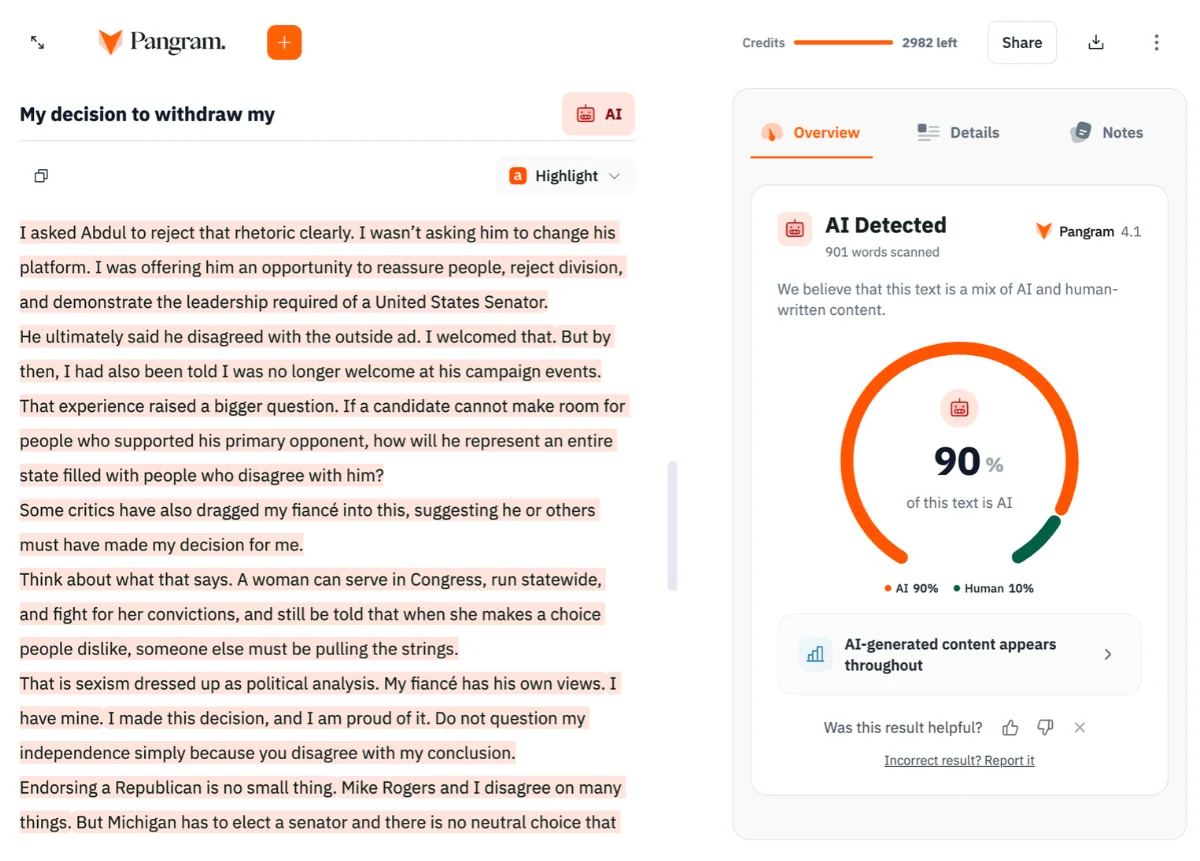
That paragraph makes a clear claim about the criticism Stevens says she has faced, while using a polished rhetorical structure that can read as formulaic. This is more significant than it looks: in a political statement, readers judge not only the reasoning but also whether the words sound like the candidate’s own account. Stevens had not immediately responded to a request for comment. Without an explanation from her, the detector result and the prose itself leave the authorship question open.
Political writing faces growing AI scrutiny
The question lands amid wider concern about chatbots in government work. Earlier this year, The Washington Post reported that AI is being used to draft substantial amounts of legislation, with little oversight. Politicians in the US and abroad have also been found leaving AI-generated text on campaign websites and in speeches. These examples point to a practical problem: when AI helps produce public-facing language, audiences may not know whether it shaped a sentence, a draft, or the finished message.
That distinction matters. A candidate could use a writing tool for editing and still choose the argument and wording; a detector score alone can’t tell readers which process occurred. Nor does a claim that text may be AI-assisted answer whether the statement accurately represents the author’s views. In Stevens’ case, the detector’s result is a signal, not proof of who wrote the post; her response could clarify how it was prepared. Here's the thing: the political stakes of the endorsement are already clear, while the authorship claim remains unresolved.
What the result can—and can’t—tell readers
If you're working in this space, the distinction between a detection score and verified authorship is familiar, but it can get lost when a striking percentage becomes the headline. The score may prompt reasonable questions about process and transparency. It can’t, on its own, establish that Stevens personally used a chatbot or that AI produced a particular passage. The underwhelming part is that the number sounds conclusive while the available evidence isn’t.
For readers, the immediate test remains the substance of the post: whether Stevens’ explanation addresses her change in support and persuades people who object to it. The style may shape how audiences receive that explanation, especially when the statement is meant to sound personal. But a detector’s estimate is only one piece of evidence. A direct account of how the post was drafted would be more useful than speculation based on phrasing.
More on AI-generated content in politics: The Logo for Donald Trump International Airport Appears to Be AI Slop
The post Did Haley Stevens Use AI to Write Her Blog Post About Her Controversial Endorsement? appeared first on Futurism.

Discussion
Sign in to join the discussion.