A NASEM report identifies four nonpolar lunar destinations and calls for longer astronaut traverses, durable instruments and stronger mission support.
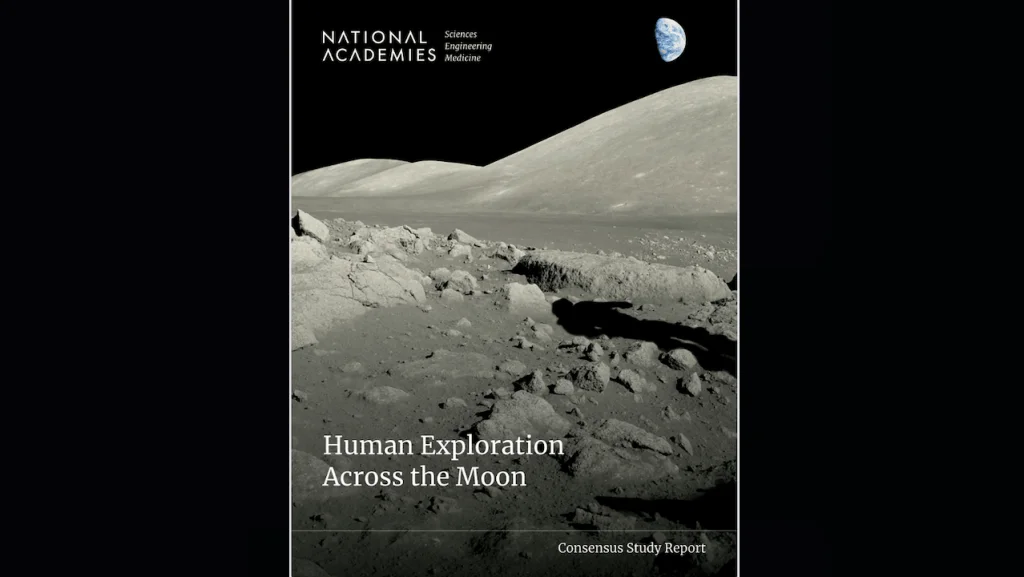
Future crewed lunar missions could do more than revisit familiar ground. A new report from the National Academies of Sciences, Engineering, and Medicine (NASEM) recommends four nonpolar destinations—Bhabha Crater, Mons Hadley, the Orientale Basin and the Aristarchus Plateau—where astronauts could pursue scientific questions spanning lunar geology, astronomy, human health and future habitation.
The choice reflects a scientific advantage of the moon: its surface preserves a long record of impacts and geological processes. With volcanic activity ending more than a billion years ago and no plate tectonics, lunar materials can help researchers investigate the moon’s formation and the history of objects that struck it. Exploration could also identify resources useful for technology and sustained human activity.
“The four sites that our report recommends would give astronauts the chance to study questions as varied as how to use lunar soil to grow plants, to understanding the sources of gravitational waves,” said Daniel Dumbacher, a committee co-chair and professor of engineering practice at Purdue University. He said the destinations offer strong scientific opportunities for crewed missions beyond the lunar South Pole.
Four destinations, distinct research goals
Bhabha Crater, on the moon’s far side, would take astronauts farther from Earth than any human explorers have traveled. Its location offers access to material from the oldest preserved lunar impact basin and a chance to study the far-side crust. The site could also host radio and optical astronomy experiments. Because the far side is shielded from Earth’s radio frequency interference, it may be especially useful for radio astronomy and other observations of the universe.
Mons Hadley sits on the near side, close to the Apollo 15 landing site. A return visit could examine equipment and biological materials that have been exposed to the lunar environment for more than 50 years, alongside new geological samples. Those findings could inform Artemis missions and planning for human exploration from the moon toward Mars. The report also points to the area as a candidate for a space weather observatory and tests of whether lunar surface material can help reduce radiation hazards.
The Orientale Basin, near the outer edge of the moon’s visible disk, is described in the report as the best-preserved large multi-ring impact basin in the solar system. Its varied geology and seismically quiet setting could help researchers probe the moon’s deep structure and origin. Crews could collect samples for return to Earth to clarify how the basin formed, and deploy a gravitational wave observatory.
At the Aristarchus Plateau, ancient lava flows frame a geologically rich volcanic region. Samples from the plateau could reveal the range of volcanic processes that shaped the moon and help identify resources that might support later exploration. Like Mons Hadley, the area could also support space weather monitoring and research into radiation protection using lunar material.
James Day, the report’s other committee co-chair and a professor at Scripps Institution of Oceanography and the University of California, San Diego, said visits to unexplored sites could give scientists access to information unavailable from previous missions. He described returning to the moon and reaching new terrain as a major opportunity for science.
Mission capability will shape the science
The report says NASA should expand astronauts’ ability to travel beyond the current 2-kilometer limit for extravehicular exploration. It also recommends instruments that can keep operating through multiple lunar day-and-night cycles, a high-resolution observational tool in lunar orbit to support mission safety and planning, and a simple unpressurized rover for short crewed trips. Continuous communications for people working on the surface are another recommended capability.
These requirements point to a practical constraint: selecting scientifically valuable sites only matters if crews can cover enough ground, keep instruments running and stay connected. The report also identifies questions in biology and human health, including whether lunar soil could contribute to growing plants for longer-term habitation.
NASA sponsored the study, conducted by the Committee on Key Nonpolar Destinations Across the Moon to Address Decadal-Level Science Objectives with Human Explorers. The National Academies report is available from NASEM. The proposed sites set out a broader scientific agenda for human lunar missions; realizing it will depend on the mobility, instruments and communications crews can bring to the surface.


Discussion
Sign in to join the discussion.