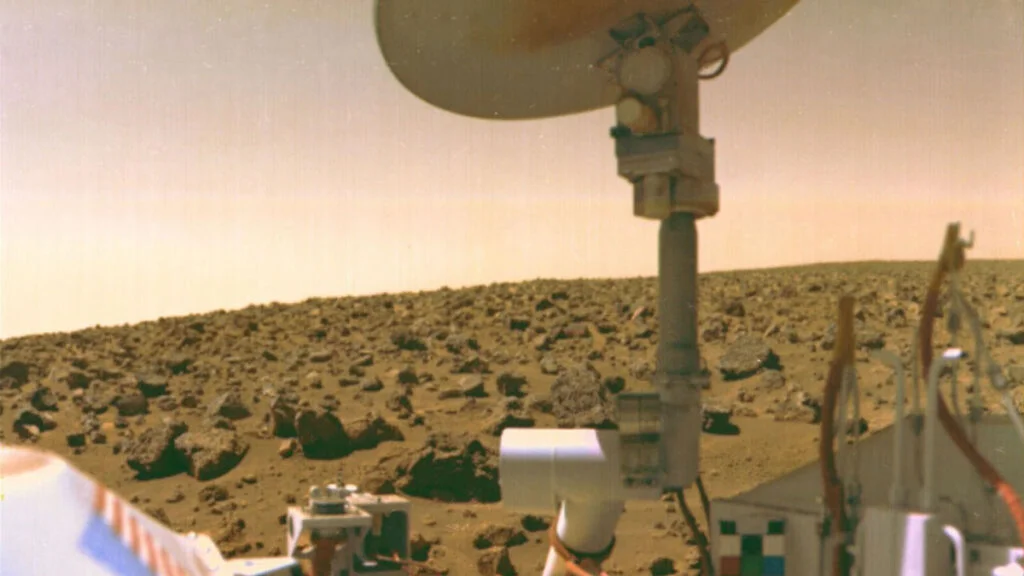
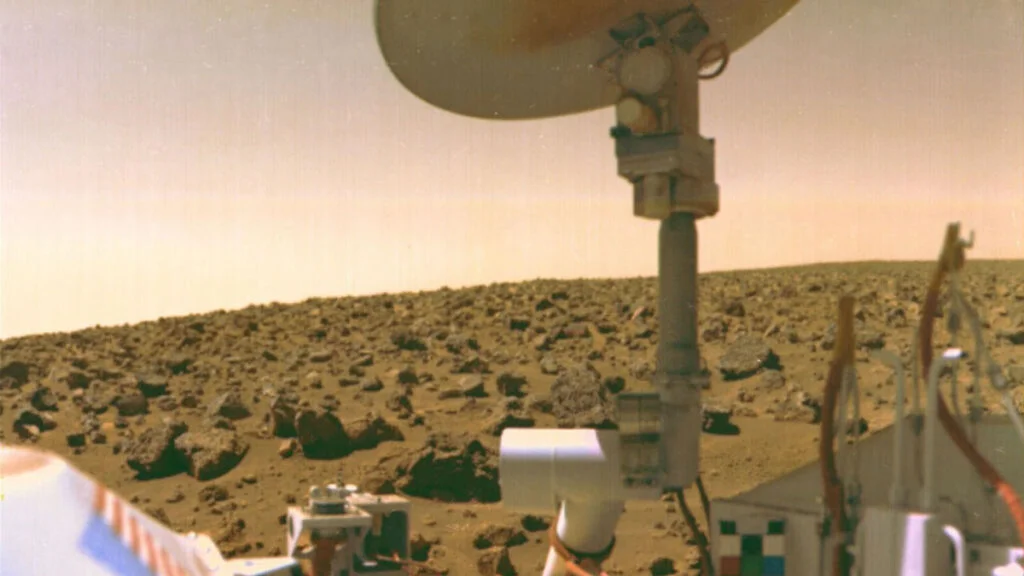
A reanalysis of Viking 2 data suggests Mars may have quaked in a region where InSight later recorded nearly 1,000 seismic events.
Source: AGU Advances
A possible marsquake in the Viking record
One uncertain signal from a 1970s Mars lander may connect Viking-era seismology with the much richer record gathered decades later by NASA’s InSight mission. A reassessment by Xiao et al. finds that one of two ambiguous events detected by Viking 2 could have been a marsquake. Its possible source region overlaps with an area where InSight later registered nearly 1,000 quakes. That overlap gives the old signal a useful geological context, though it doesn't establish that the Viking and InSight events came from the same fault or process.
The comparison draws on data from NASA’s InSight (Interior Exploration using Seismic Investigations, Geodesy and Heat Transport) lander, which operated on Mars from 2018 to 2022. Its ground-placed seismometer detected more than 1,300 seismic events, giving researchers a stronger basis for evaluating the sparse Viking record. Seismologists can use that larger catalogue to ask whether the older signal resembles activity associated with a region later known to produce quakes. It doesn't make the earlier measurement clearer by itself, but it changes how plausibly researchers can interpret it.
Why Viking's measurements were hard to read
That record was difficult to interpret. Viking 1’s seismometer never deployed correctly, while Viking 2’s instrument sat on the lander deck, where wind created substantial noise. The two signals it reported may have come from marsquakes—or from wind interference. The new analysis doesn't settle the question, but it makes a seismic origin for one event plausible. The distinction matters because a seismometer records ground motion without automatically identifying its cause; noise can obscure or mimic the patterns researchers seek.
InSight had a practical advantage: its seismometer was placed on the ground, away from some of the mechanical and environmental effects that complicated Viking 2's deck-mounted instrument. Even with that improved setup, interpreting seismic signals requires separating likely marsquakes from other sources of motion and instrument noise. The comparison therefore runs in both directions: InSight's broader record helps researchers assess the Viking candidate, while Viking offers a reminder of how much uncertainty can remain in early planetary measurements. A suggestive match is evidence to examine, not a verdict.
What a long-lived seismic region could mean
If that interpretation holds, the region may have remained seismically active across nearly five decades, spanning the Viking and InSight missions. The finding also gives fresh context to Viking’s scientific ambitions: although the mission sought signs of life, understanding Mars’s internal structure and tectonic activity could help explain the geological history that shaped the planet’s habitability. This is more significant than it looks. A possible link between observations separated by decades would show how later, better-resolved data can give older measurements new scientific value.
That said, the source region's overlap doesn't demonstrate continuous activity throughout the gap between the missions. The observations establish two windows into Mars, with a long interval between them; they don't provide a year-by-year account of what happened in the crust. (And this is the part most people overlook.) A sparse early record can become more useful when compared with later observations, but the comparison can't recover details the original instrument never captured. A plausible interpretation is a step forward, with the uncertainty still attached.
Why planetary seismology depends on patient comparison
Earthquake waves have long helped scientists probe Earth’s interior. Apollo seismometers demonstrated that the method could work beyond Earth, but Viking’s Mars measurements offered little clarity. This reanalysis suggests those early observations may still contain a useful clue—and that better records from later missions can help extract it. The broader lesson is methodological: planetary science often advances by revisiting imperfect measurements as new instruments provide a reference point. Here's the thing: old data don't become reliable simply because newer data exist; they become more useful when researchers can test competing explanations against a richer body of evidence.
For readers following Mars exploration, the result also puts instrument design in view. Sensor placement, background noise, and the number of recorded events shape what scientists can responsibly infer about another world. If you're working in this space, the practical takeaway is that mission records can have value well beyond their original operating period, especially when later measurements let researchers revisit an ambiguous signal. A clue, not a complete history. (AGU Advances, https://doi.org/10.1029/2026AV002319, 2026)
—Matthew R. Francis (@BowlerHatScience.org), Science Writer



Discussion
Sign in to join the discussion.