Mars holds vital geological records and climate histories that could transform our understanding of the planet, but terraforming efforts may risk erasing them.
Martian History on the Brink
Carl Sagan's longing to visit the Library of Alexandria reminds us of a lost trove of human knowledge that shaped our understanding of the cosmos. This "cosmic library" metaphor extends compellingly to Mars. The Martian surface is inscribed with a geological narrative that spans 4.5 billion years of our solar system’s evolution. Unfortunately, much of this story remains unread, and it’s now at risk amid the growing urgency to transform Mars into an Earth-like habitat. Decades of exploration have unveiled tantalizing hints of ancient environments—oceans, rivers, snow, and even complex organic molecules exist as silent witnesses to the planet’s past [e.g.,Murphy et al., 2026]. Yet, crucial questions linger: Why did Mars become the cold, barren wasteland we see today, while Earth thrived? Does Mars still hold proof of life? Terraforming efforts aimed at adjusting Martian conditions could erase these invaluable records, akin to burning the very scrolls of a significant archive.
Recent studies, fueled by private capital, are delving into innovative solutions for warming Mars. One ambitious proposal involves introducing metallic nanoparticles into the Martian atmosphere, potentially increasing temperatures by 30°C over the next century [e.g., DeBenedictis et al., 2025]. This method differs from previously dismissed strategies focused on liberating CO2 from Martian soils due to the planet's limited residual resources. Instead, it aims to create an insulating layer in the atmosphere, leading us towards a more habitable environment.
Significantly, heavy-lift rockets like SpaceX's Starship, designed for Mars exploration and settlement, are evolving rapidly, making the prospect of terraforming feel less like a distant dream and more like a tangible goal. But as this vision gains momentum, we must reflect critically on the consequences. Rushing to transform Mars without a thorough understanding of its unique climatic records would be an egregious mistake—one we might regret in the long run.
The Treasure of Martian Ice
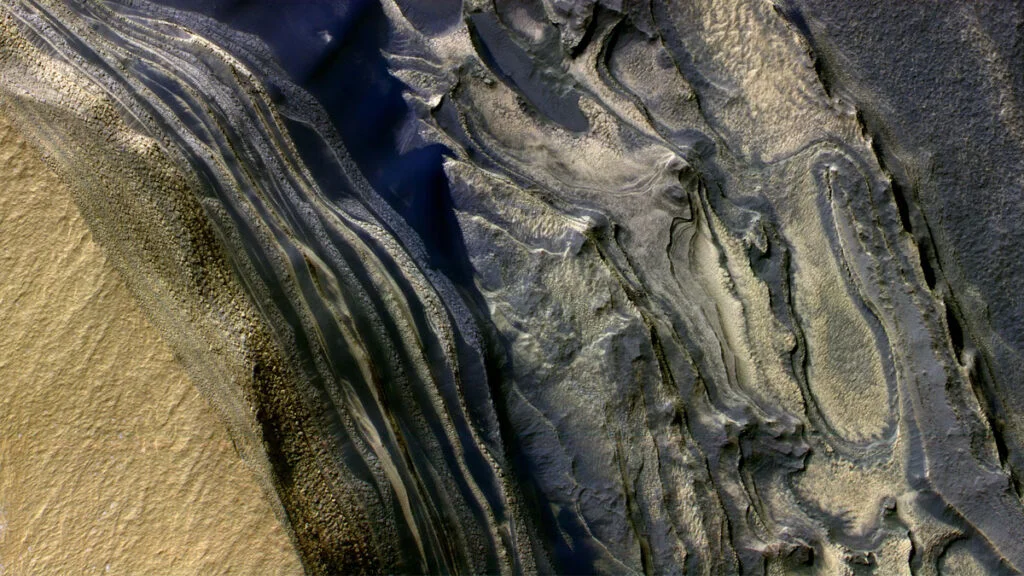
At the center of this cosmic library lie the ice cores of Mars, which harbor rich climate histories. Much like the ice cores from Earth's polar regions that have revolutionized our understanding of climate dynamics, Martian ice holds the potential to unlock unprecedented insights into the planet's past. Yet no mission has yet sampled these crucial records. The polar ice deposits on Mars capture perhaps up to 30 million years of climate evolution, representing one of the most extensive ice records available for study within our solar system [Phillips et al., 2008; Becerra et al., 2019]. Furthermore, deeper ice layers might extend this record by an astounding 470 million years [Arnold and Butcher, 2025]. This treasure trove could provide crucial data on Martian climate changes influenced by its axial tilt and other orbital variations, potentially revealing Earth-like cycles of atmospheric and geological dynamics. Most importantly, it raises profound questions: Did Mars ever support life? The answers could redefine our understanding of the universe and our place within it. Yet if terraforming hastens climate alterations, the stratigraphy of these ice layers could be irreparably disrupted, erasing the very clues we seek. Above all, this ice may also contain evidence of past life, with microbial habitats likely existing within the fringes of frozen deposits [Orosei et al., 2018]. What if evidence confirms life on Mars? Such a finding would be monumental, shaping our scientific discourse for generations. However, if we hasten warming on Mars, we risk obliterating these records and forever losing critical insights into both Mars and the larger narratives of planetary evolution. As we stand on the precipice of potential terraforming endeavors, leaders in the scientific community must navigate these choices carefully. The stakes are immense, not just for Mars but for our collective understanding of life beyond Earth and the intricate histories archived on lonely worlds across the cosmos.Final Thoughts
As we reflect on the discussions and discoveries presented in this article, it's evident that the challenge of making Mars habitable carries both promise and peril. While advances in research illuminate potentials—like the understanding of subsurface water ice or the dynamics of Martian atmosphere—these findings are tethered to significant uncertainties. For instance, while we have enticing data about the presence of CO₂ and organic materials, translating that knowledge into actionable terraforming strategies won't be straightforward. Here’s the thing: with each revelation, we must weigh the ethics and responsibilities tied to altering another planet’s ecosystem. This isn't just about exploration; it's about understanding our impact on celestial bodies. What this means for you, if you're involved in planetary science or astrobiology, is a heightened need for a cautious and interdisciplinary approach. Moreover, as outlined in references such as Becerra et al. (2019) and DeBenedictis et al. (2025), climate records and terraforming research are pivotal in understanding Mars' past and future. Each study offers insights but also raises new questions about feasibility and repercussions of attempting to engineer another world. In conclusion, while Mars holds the allure of being "Planet B," the complexities involved suggest that those dreaming of a second home might need to recalibrate their expectations. The data we’ve gathered is foundational, but it’s clear: our journey to Mars is just starting, and the road ahead is fraught with challenges that extend well beyond scientific discovery. As we look forward, let's aim for a balance between curiosity and caution, ensuring that our quests don't overshadow the intrinsic value of the universe we explore.
Source:
Ari Koeppel, Lonneke Roelofs, Santiago Vrech, Alicia M. Rutledge and Martin Turbet
·
eos.org


Discussion
Sign in to join the discussion.