Recent studies indicate a significant drop in Pluto's atmospheric pressure, marking a potential onset of atmospheric collapse as it heads into winter.
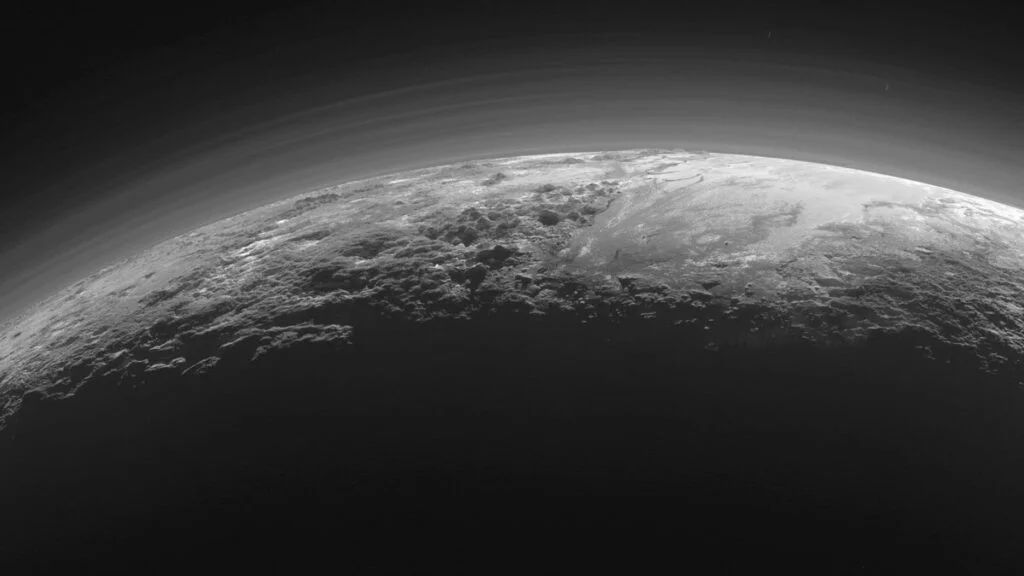
Pluto, the enigmatic dwarf planet that takes 248 years to orbit the Sun, has been a source of fascination for astronomers since its discovery in 1930. Over the years, scientists have uncovered countless peculiarities about this distant body, notably its ability to sustain an atmosphere—a rarity among celestial objects beyond Neptune's orbit. However, recent findings suggest Pluto's atmospheric stability may be in jeopardy.
Planetary scientists have long speculated that the atmosphere of Pluto, primarily composed of nitrogen, experiences significant seasonal changes in response to its erratic orbital dynamics. With emerging research data indicating a decline in atmospheric pressure, the prospect of an atmospheric collapse looms as Pluto approaches its long winter months.
Understanding Pluto's Atmosphere Through Stellar Occultation
The atmosphere of Pluto was first detected through a stellar occultation technique in 1988, wherein astronomers analyzed how light from a distant star was altered as it traversed the planet's thin gaseous layers. This observation revealed a fragile atmosphere comprising mostly nitrogen, along with trace amounts of methane and other compounds.
The major leap in understanding Pluto's atmospheric composition came with NASA's New Horizons mission in 2015, which offered unprecedented views of both Pluto's surface and atmosphere, showcasing its surprising complexity. Continuous monitoring since then has relied heavily on stellar occultations to gauge changes in atmospheric characteristics over time.
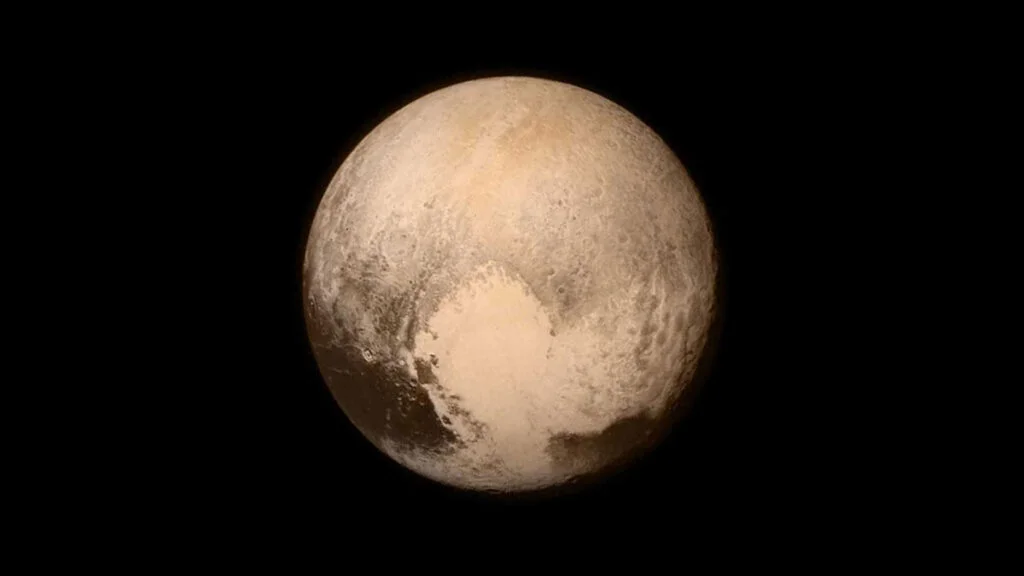
However, these occultations occur infrequently—typically once or twice annually—creating challenges in accumulating a cohesive dataset to track subtle variations in atmospheric pressure. Amanda Sickafoose, a planetary scientist at the Planetary Science Institute and lead author of the recent study, pointed out that the data collection relies on such precise alignments between Pluto and background stars, making consistency a persistent challenge.
Analyzing the Atmospheric Shift
Sickafoose's team aimed to address these inconsistencies by aggregating occultation data from 1988 to 2023, including new measurements conducted from 2017 to 2023 from over 15 global telescope sites. Their systematic analysis allowed them to derive a clearer understanding of atmospheric trends.
The findings revealed a notable discrepancy in responses between Pluto’s upper and lower atmospheric layers to the diminishing sunlight attributed to seasonal changes. “From our observations, Pluto's atmosphere showed stability from the New Horizons encounter through to 2021," Sickafoose illustrated. However, preliminary data from 2022 and 2023 indicated a concerning 16% decline in pressure within the lower atmosphere.

Further, the analysis showed that while the upper atmosphere remains without haze, the lower layers exhibit a clearance of haze particles. This phenomenon suggests nitrogen is condensing and crystallizing as the atmosphere cools, leading to snowfall-like conditions on Pluto's surface, as previously theorized.
Implications of Atmospheric Collapse
The complex interplay between temperature, illumination, and atmospheric dynamics is critical to understanding the evolution of Pluto's atmosphere. While uncertainties remain, the data suggests Pluto's atmospheric collapse is not a distant concern but rather an event that may be unfolding in real-time.
Perianne Johnson, a climate scientist at Purdue University, emphasized the significance of the findings, noting that a 16% reduction over just a few years is a rapid shift in atmospheric conditions, especially considering Pluto's lengthy orbital timeline. The potential for nitrogen crystals to accumulate as atmospheric pressure decreases presents enticing clues about the ongoing atmospheric processes.
“Pluto is the best studied TNO, and what we learn about Pluto helps put other TNOs in context.”
Current atmospheric models long predicted that a drop in pressure would occur over the coming decades, marking the beginning of a long-term decline lasting over 150 years before experiencing an eventual recovery around the 23rd century. This tightening of atmospheric pressure could provide insights into where nitrogen is presently snowing down onto the southern ice deposits of Pluto.
The next high-resolution opportunity for further study comes in 2027, when astronomers will again be able to observe occultations in greater detail. Johnson reiterated the power of these observations, emphasizing that they are vital not only for understanding Pluto but also for contextualizing other trans-Neptunian objects (TNOs) within the solar system.
—Kimberly M. S. Cartier (@astrokimcartier.bsky.social), Staff Writer


Discussion
Sign in to join the discussion.